
Clicky

Discover the best way to charge battery for longer device life

If there's one single takeaway for making your phone or laptop battery last longer, it's this: keep it charged between 40% and 80%. Forget everything you heard in the past about charging to 100%. For the modern batteries we all use now, this simple habit reduces stress on the battery and helps it last longer.

The Most Important Rule for Modern Battery Charging
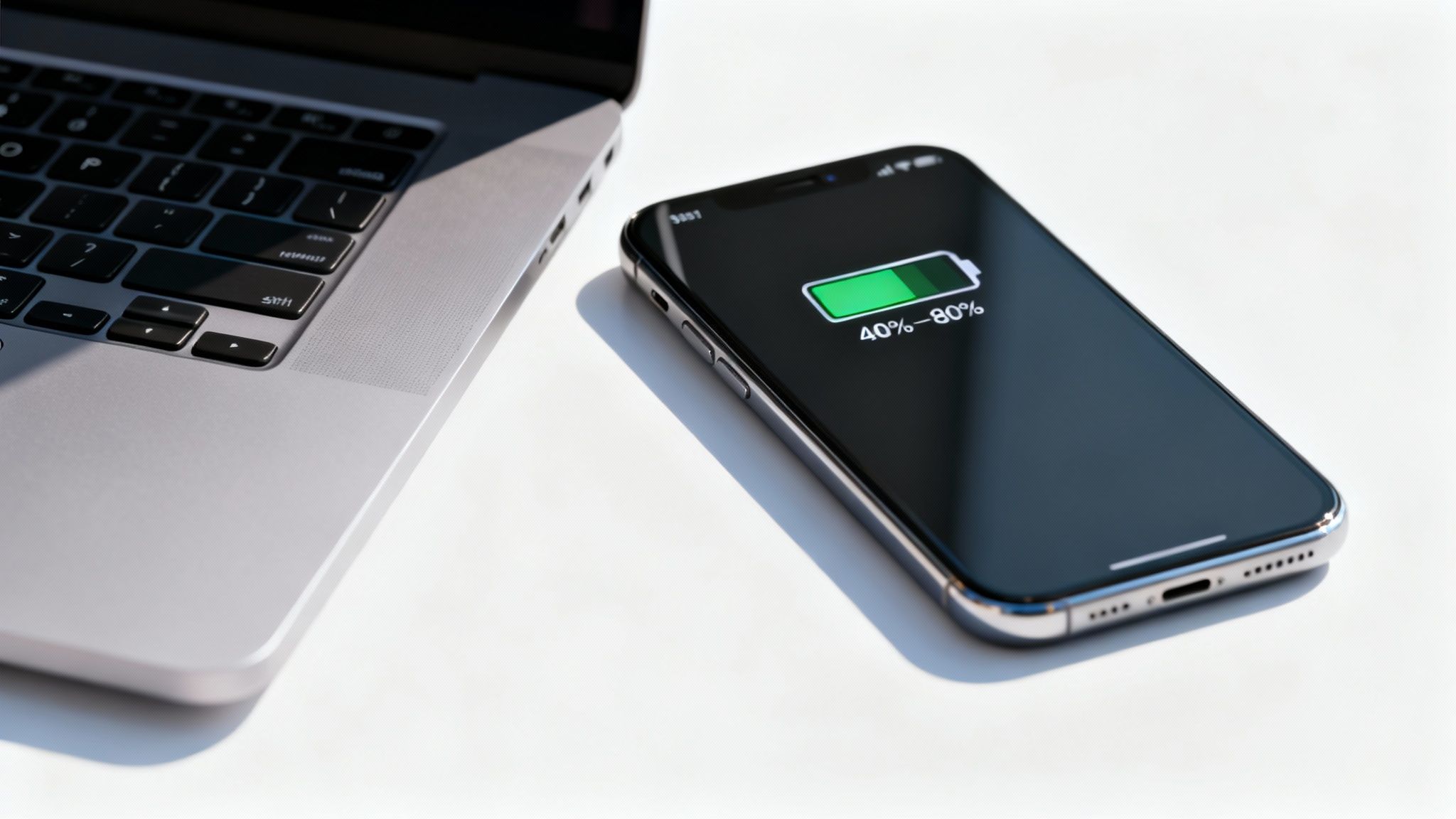
A smartphone displaying 40-80% battery charge sits next to a laptop on a white surface.

Let's be honest, most of us are still stuck on charging habits from a decade ago. We let our phones get very low, then plug them in all night to wake up to a full 100%. While this used to be the right move for older battery types, it’s actually damaging the batteries in your devices today.

The real key to a long, healthy battery life is to simply avoid the extremes. Constantly pushing a battery all the way to 100% or letting it drain completely to 0% puts a ton of strain on it. Think of it like a muscle—if you constantly push it to its absolute limit without any rest, it's going to wear out much faster.

Adopting a Healthier Charging Cycle

A much better approach is to be gentler with your battery. Instead of one huge charge from empty to full, aim for shorter, more frequent top-ups throughout the day. Plugging your phone in for 20 minutes here and there to keep it in that 40-80% sweet spot is far better for its long-term health.

This method, often called partial charging, prevents the high-stress conditions that cause batteries to wear out over time. It’s a small change to your daily routine, but it can make a huge difference in how long your devices last, saving you from slow performance and the cost of an early battery replacement.

The goal isn't to be perfect, but to be consistent. Simply avoiding the extremes of 0% and 100% on a regular basis will make the biggest difference in keeping your battery healthy over the years.

Old Habits vs. Modern Methods

To really make this clear, let's look at how the old advice most of us grew up with compares to the smart methods that work for today’s technology. The difference is pretty big, and understanding it is the first step toward charging smarter.

This table shows those old, harmful habits next to the new rules that will actually make your battery last longer.

Modern vs. Outdated Battery Charging Habits

Charging Habit Outdated Method (Harmful) Modern Method (Recommended)
Charge Target Always charge to 100% to "get the most out of it." Aim for an 80% charge limit for daily use.
When to Charge Wait until the battery is almost dead (below 10%). Start charging when the battery drops to around 40%.
Charging Duration Leave it plugged in overnight for a full charge. Unplug once it hits the target, or use a smart charging tool.
Overall Strategy One long charge cycle from nearly empty to full. Short, frequent top-ups to stay in the ideal range.

As you can see, the modern approach is all about moderation. By ditching the all-or-nothing mindset, you can keep your device’s power source in great shape for much, much longer.

Why the 40-80% Range Is a Game-Changer
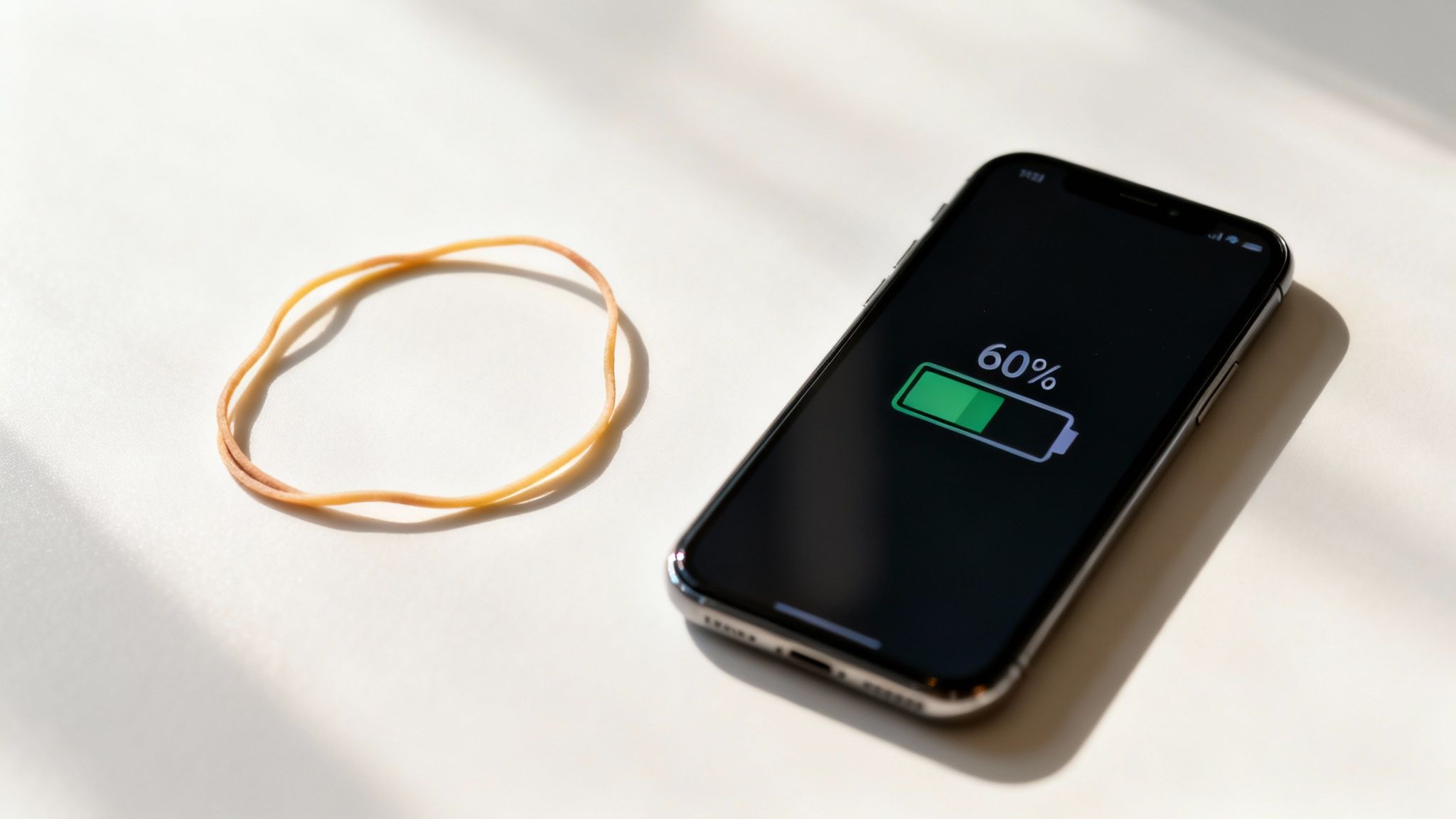
A smartphone displaying 60% battery charge next to a rubber band on a white surface.

So, why is it so important to keep a battery between 40% and 80%? It might sound a bit nitpicky, but there's a simple reason it works so well.

Forget the complex science for a moment and think about a rubber band.

If you have a brand-new rubber band, you can stretch it a little, let it go, and do this thousands of times without any problems. It just works.

But what if you stretched that same rubber band as far as it could go and held it there for hours? Or, what if you constantly let it go completely loose? It wouldn't take long for it to lose its snap, get weak, and eventually break. It’s the extremes that do the real damage.

Your phone's battery works in a surprisingly similar way. Pushing it all the way to a 100% charge or letting it die completely to 0% puts it under a lot of stress. The 40-80% range is that comfortable middle ground, the low-stress zone where your battery can live a long and happy life.

The Problem with Hitting 100%

When you charge your battery to its maximum, the parts inside have to deal with high electrical pressure and rising temperatures. Leaving it plugged in at 100%—especially overnight—is like holding that rubber band at full stretch for eight hours straight.

This constant stress wears down a critical part of the battery that holds the charge. Over time, this damage permanently shrinks your battery's total capacity. You’ll eventually notice that a "full" charge just doesn't last like it used to. Finding the best way to charge battery really just means avoiding this high-stress state whenever possible.

On the other hand, letting the battery drain completely is just as bad. Letting the battery hit 0% can cause problems inside that make it harder for the battery to hold a charge in the future.

Staying within the 40-80% zone isn't about being perfect; it's about being smart. By avoiding the punishing extremes of 0% and 100%, you dramatically slow the aging process and keep your battery holding a strong charge for years, not months.

Understanding Charge Cycles and Longevity

Every battery is rated for a certain number of "charge cycles" before it starts to fade. A full cycle is one complete drain from 100% to 0%. But this doesn't mean you only have a few hundred charges before your phone is useless.

Partial charges are much, much gentler. In fact, charging from 40% to 80% uses only a small fraction of a cycle compared to a full 10% to 100% charge.

Here's an easy way to think about it:

  • Shallow Charges: Little top-ups here and there (like going from 50% to 70%) cause almost no wear.
  • Moderate Charges: Sticking to the 40-80% rule is a sustainable, low-stress strategy for daily use.
  • Deep Charges: Regularly going from nearly empty to completely full is what causes the most rapid aging.

This is exactly why topping up your phone a bit during the day is a far better strategy than the old "let it die, then charge it all night" habit. You get more total use out of your battery's lifespan by treating it gently.

The Role of Modern Battery Management

This isn't just a clever user tip; it's a key idea for the entire battery industry. The global battery market is built on advanced charging tech designed to make batteries safe and long-lasting.

Industry research has confirmed again and again that keeping a battery within certain electrical limits is key to its survival. Modern systems constantly watch the battery's charge level to prevent the damaging effects of overcharging or deep draining—the two main reasons batteries lose power. You can see how this is an industry-wide focus in deep dives into battery technology.

This is the science behind finding the best way to charge battery. It’s not guesswork. When you adopt the 40-80% habit, you're basically using the same rules engineers rely on to make batteries last, helping your devices perform well for as long as you own them.

How Heat and Fast Charging Secretly Harm Your Battery

Charge levels are only part of the story. Two silent problems are constantly working against your battery's health: heat and the super-convenient fast charging. If you've ever picked up your phone while it was plugged in and felt it was uncomfortably warm, you've experienced the number one cause of battery damage firsthand.

Think of your battery as a tiny, sensitive engine. When you push it too hard—either by charging too fast or using it in a hot place—it creates extra heat. That heat speeds up the chemical processes inside, causing the internal parts to break down far faster than they should. Honestly, finding the best way to charge battery often just means keeping it cool.

Simple Ways to Keep Your Device Cool

You don't need a complicated solution to manage heat. A few small changes to your charging habits can have a massive impact on your device's long-term health. The goal is simple: give your battery a chance to breathe while it powers up.

Here are a few practical tips you can start using today:

  • Remove the Case During Charging: Phone cases are great for protection, but they're also great at trapping heat. Taking the case off before you plug in lets the heat escape much more easily, keeping the battery in its happy zone.
  • Avoid Direct Sunlight: This one seems obvious, but it's easy to forget. Never leave your phone, tablet, or laptop charging on a sunny windowsill or, worse, in a hot car. The combination of charging heat and outside heat is a recipe for faster battery aging.
  • Pause Heavy Tasks: Try to avoid playing demanding games or streaming high-quality video while your device is plugged in. These activities make the processor work hard, which creates its own heat and adds to the warmth from charging.

The most important thing to remember is that heat is the number one enemy of a healthy battery. A cool battery is a happy battery, and even small changes to lower its temperature during charging can add years to its usable life.

The Hidden Cost of Fast Charging

Fast charging feels like a modern miracle, especially when you're in a hurry. Getting a 50% boost in just 30 minutes is incredibly convenient, but that speed comes at a price. Pushing that much power into a battery so quickly creates a lot of heat and puts immense stress on it.

I like to think of it like filling a water balloon. You can fill it slowly and gently with no problem. But if you turn on a fire hose and blast it, the balloon's material stretches violently and is far more likely to weaken or burst. Fast charging has a similar, though less dramatic, effect on your battery over time.

This technology has become essential for people who need quick power-ups, and its growth is huge. The fast charge battery market is projected to skyrocket from USD 25.58 billion in 2024 to USD 124.39 billion by 2035, driven by newer methods that try to balance speed with safety. You can read more about the trends in the fast charge battery market to see just how quickly this space is evolving.

When to Use Fast Charging (and When to Avoid It)

So, does this mean fast charging is always bad? Not at all. It’s a tool, and the key is knowing when to use it. The best approach is to use it only when needed—save it for those moments when you genuinely need a quick top-up before heading out the door.

For your daily, routine charging—especially overnight—a slower, standard charger is a much healthier choice. The gentle, low-temperature charge it provides is far less stressful on the battery, helping it last longer. You can learn more about why slow charging is essential for your smartphone's battery health in our detailed guide on the topic.

By being mindful of both heat and charging speed, you take back control over two of the biggest factors in battery damage. This balanced approach—using fast charging only when you really need it and prioritizing cool, slow charging for regular use—is a key part of keeping your battery in great shape for years.

Using Smart Tools to Automate Perfect Charging

Let's be real: trying to manually unplug your phone the second it hits 80% is a huge pain. It's just not practical for most of us. The good news is, you don't have to watch your devices anymore. Modern tech can do the heavy lifting for you, making smart charging an automated, set-it-and-forget-it process.

Device makers know that leaving a phone plugged in at high-stress levels kills batteries. That's why they've started building smart charging solutions right into their software, working quietly in the background to save your battery from aging too quickly.

Built-In Smart Charging Features

Your smartphone probably already has a feature designed to solve the overnight charging problem. Both Apple and Google have created systems that learn your daily routine to charge your phone more intelligently while you're asleep.

Instead of rushing the battery to 100% and letting it sit there for hours, these systems charge up to about 80% and then hit pause. They wait until just before you usually wake up to finish the job, so it hits 100% right around the time your alarm goes off.

  • Apple's Optimized Battery Charging: This is standard on iPhones and uses the device's software to figure out your charging patterns and daily schedule.
  • Android's Adaptive Charging: Google's version does pretty much the same thing, timing the charge to be full just as you're starting your day.

These tools are a great first step against battery damage. They dramatically cut down the time your device spends maxed out at that stressful 100% state, which is a huge win for its long-term health.

But even with these features, fast charging can still create a lot of heat—the number one enemy of a healthy battery.
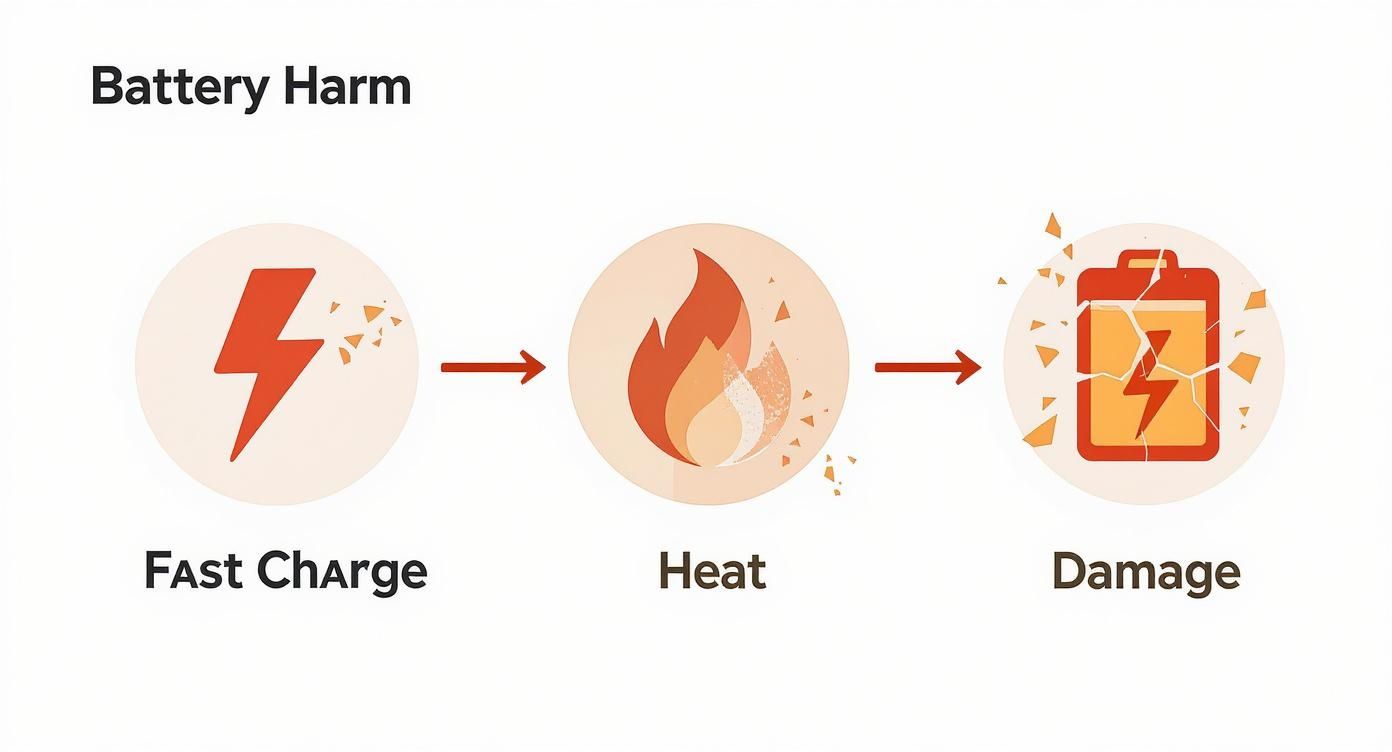
An infographic illustrating how fast charging can lead to battery overheating and damage.

This simple graphic shows how the rush to get a quick power-up often creates extra heat, which is the main thing that makes batteries wear out faster.

Taking Control with Third-Party Tools

While the built-in features are a great start, they don't give you much control. You can’t tell your iPhone to stop at 85%; you just have to trust the software. For those who want more precise management, special third-party tools offer a much more powerful and customizable approach.

This is where a tool like Chargie comes in. It's a small hardware device that acts as a smart switch between your charger and your phone. Paired with an app, this little gadget lets you set an exact charging limit—say, 82%—and it will automatically cut the power once your phone reaches that level.

This level of control makes it effortless to stick to the 40-80% sweet spot. It completely automates the process, so you can plug your phone in at night and forget about it, knowing it won't be overheating at 100% for hours.

Why Automation Is the Future of Battery Care

At the end of the day, automation is what makes proper battery care actually happen. Relying on yourself to unplug your phone at the right time is likely to fail, but letting smart hardware and software handle it ensures you're always doing it right. A dedicated battery charge limiter like the one from Chargie can also do things that go way beyond a simple percentage cap.

For example, the Chargie app lets you schedule your charging sessions. You can set it to keep your phone at a very low-stress 50% for most of the night, then have it automatically top up to 80% just before you wake up. This gives you the best of both worlds: smart timing combined with a precise charge limit.

Whether you stick with your phone's built-in features or grab a dedicated tool, automating your charging habits is the single most reliable way to extend your battery’s life and keep it performing like new for years to come.

Common Charging Mistakes Almost Everyone Makes
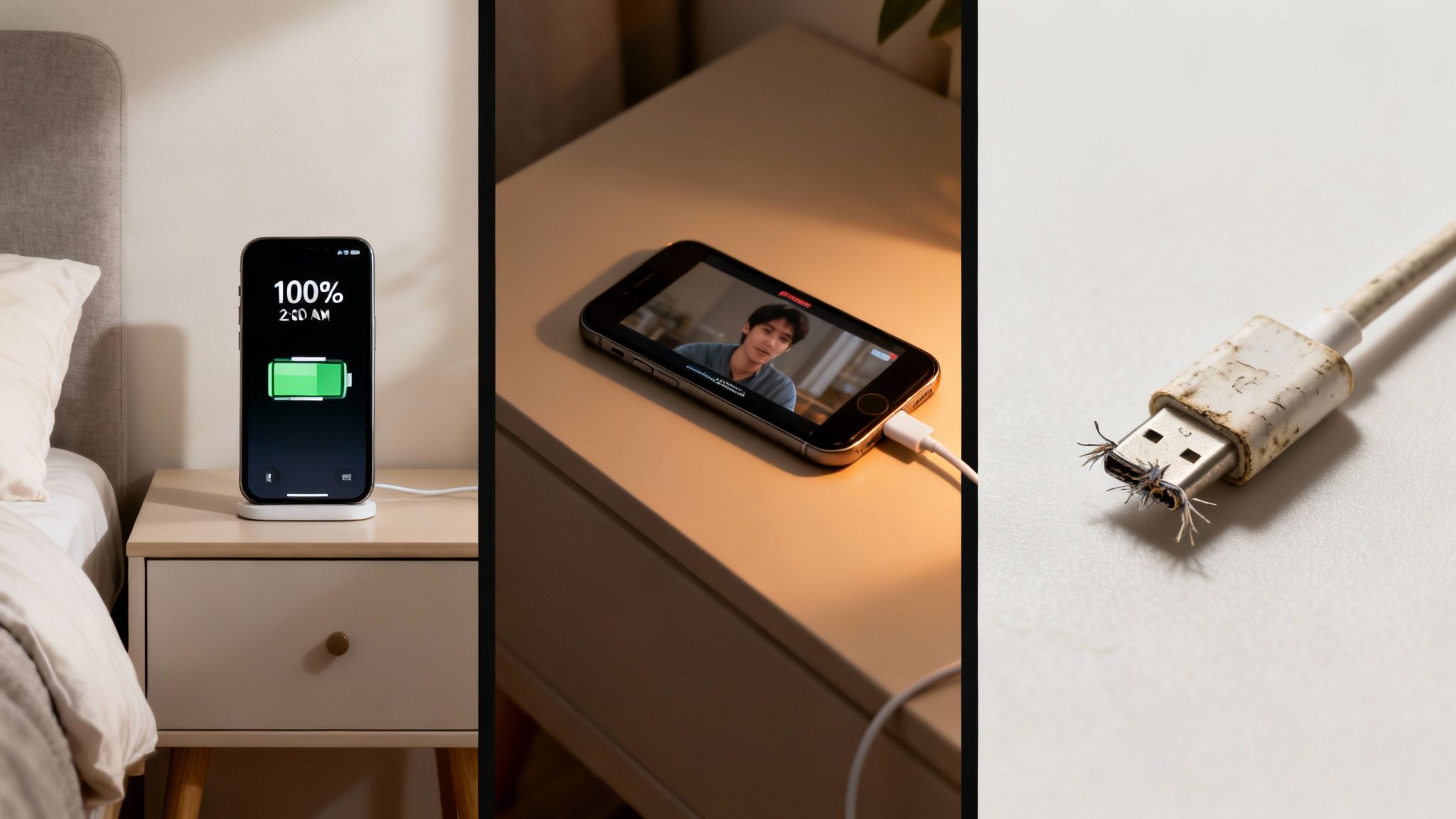
A multi-panel image displaying a fully charged phone, a phone during a video call, and a frayed charging cable.

Knowing how to care for your battery is one thing. Actually spotting our own bad habits? That’s where the real change happens. So many of us fall into charging traps without even realizing it, slowly wearing down our device's lifespan one day at a time.

These common mistakes often feel harmless, but their combined effect over time is what leads to a battery that just can't hold a charge anymore.

Let's look at a few classic examples you might recognize. By finding these patterns in your own routine, you can make simple changes that add years to your battery’s health.

The Dedicated Overnight Charger

This is probably the most common habit of them all. You plug your phone in at 10 PM, it hits 100% by midnight, and then it spends the next seven hours "trickle charging." It's constantly getting little top-offs to stay at that maximum level, which is incredibly stressful for the battery.

Keeping a battery at 100% creates high electrical pressure and heat. It’s like holding a muscle in a tensed position for hours on end—it causes unnecessary strain and makes it wear out faster.

While modern phones have safety features to prevent dangerous overcharging, they can't stop the gradual damage from being in a high-stress state for too long. If you want to learn more, you can read about why you should reconsider charging your phone overnight.

The fix is surprisingly simple. Use your phone's built-in "Optimized Charging" or "Adaptive Charging" features. For even better control, a smart charging device like Chargie that physically cuts the power at 80% is the best solution.

The Heavy-Duty Multitasker

We’ve all been there. You're on a long video call or deep into a gaming session when the low battery warning pops up. You plug in the charger and keep going, but your phone starts getting uncomfortably warm. This is a classic recipe for a high-heat situation that’s terrible for your battery.

When you use your device for intense tasks, the processor works hard and creates heat. At the same time, charging produces its own heat. Combining these two activities creates a perfect storm for battery damage.

Charge it or use it, but try not to do both heavily at the same time. If you absolutely must charge while using your phone, stick to lighter tasks like browsing or listening to music. Giving your device a break during charging is one of the easiest ways to protect its long-term health.

The Bargain Cable Shopper

It's so tempting to grab that cheap, no-name charging cable from the gas station or a random online seller. But honestly, using uncertified, low-quality chargers and cables is one of the riskiest things you can do. These products often lack the proper safety parts to control the flow of electricity.

This can lead to a whole host of problems:

  • Inconsistent Power: The charger might deliver a jumpy, unstable current that stresses the battery.
  • Overheating Risk: Poorly made chargers can overheat themselves and your device, creating a real fire hazard.
  • Port Damage: Flimsy connectors can physically damage the charging port on your phone or laptop over time.

The fix is straightforward: always use the original charger that came with your device or a high-quality, certified one from a brand you trust. Look for certifications like MFi (Made for iPhone), UL, or CE on the packaging. Spending a few extra dollars on a quality cable is cheap insurance for your expensive electronics.

To make it even clearer, here’s a quick rundown of some common charging mistakes and how to avoid them.

Troubleshooting Common Charging Problems

Common Mistake Why It's Harmful The Simple Fix
Leaving it plugged in at 100% for hours. High electrical pressure and heat speed up aging, reducing the battery's lifespan. Unplug once it's full, or better yet, use a tool to stop charging at 80%.
Using the device heavily while it's charging. This combines heat from the processor and heat from charging, cooking the battery. Let your device rest while it charges, especially during heavy tasks like gaming.
Draining the battery completely to 0%. Draining the battery completely puts a lot of strain on the battery cells. Try to plug in when your battery is around 20-30%.
Using cheap, uncertified cables and chargers. They can deliver unstable power, overheat, and even damage your device's port. Stick to the original charger or certified third-party brands (look for MFi, UL, CE).
Charging your phone in a hot car or direct sunlight. Outside heat sources add to the heat created during charging, which is a killer for battery health. Always charge your device in a cool, well-ventilated area.

By being mindful of these small habits, you can make a massive difference in how long your battery performs at its peak. It's not about being perfect, but about avoiding the worst mistakes.

Your Questions About Battery Charging, Answered

Even after getting the basics down, a few questions always seem to pop up when you're trying to figure out the best way to charge your specific phone, tablet, or laptop. Think of this as a final run-through, where we'll tackle the most common questions with simple, no-nonsense answers. The goal is to get you feeling completely confident in your new charging habits.

Let's clear up some of the most frequent questions we hear.

Is It Really That Bad to Leave My Phone Charging All Night?

Yes, it generally is. While modern phones are smart enough to stop pulling power once they hit 100% (so you don't have to worry about a dangerous "overcharge"), that's not the real problem. The real issue is stress.

When your battery stays at 100% for hours, it's held under high electrical pressure. This puts a constant strain on it, speeding up the aging process.

A much healthier approach is to use your phone's built-in optimized charging feature. This usually brings your battery up to around 80% and then cleverly waits to add the last 20% until just before you normally wake up. If your device doesn't have this feature, your battery will thank you for either unplugging it before bed or using a smart tool like Chargie to manage it for you.

Should I Let My Battery Drain to 0% Before I Plug It In?

Absolutely not. This is probably the most stubborn and damaging myth still around from the old days of different battery types. For the modern batteries in all your current gadgets, a deep dive to 0% is one of the most stressful things you can do to it.

Draining the battery completely can cause permanent damage, leading to a permanent drop in its total capacity. It's so much better to do frequent, shallow charges. Topping it up a bit here and there throughout the day keeps it in its happiest, healthiest state.

Key Takeaway: The "let it die completely" rule is officially dead. Avoid draining your battery to 0% whenever you can. A quick top-up when it hits 30% or 40% is always a better strategy for long-term health.

Does Fast Charging Ruin My Battery?

It won't "ruin" it in one go, but it definitely causes more wear and tear than slower charging. The main problem here is heat. Fast charging works by pushing a massive amount of power into the battery very quickly, which naturally creates a lot more heat. And as we've already covered, heat is the number one enemy of a healthy battery.

It’s perfectly fine to use a fast charger when you're in a pinch and need power now. But for your regular, everyday charging—especially the overnight session—sticking with a standard, slower charger is a much better choice. That gentle, cooler charge puts way less strain on the battery.

Do I Have to Use the Charger That Came in the Box?

While using the original manufacturer's charger is always the safest bet, you aren't strictly locked into it. High-quality, certified chargers from reputable third-party brands are perfectly fine and safe. The key word here is certified.

Steer clear of those super-cheap, unbranded chargers you find at a gas station or from a random online seller. These products often cut corners on safety features, which can lead to unstable power, damage your battery, or even become a fire hazard. Always look for safety certifications like UL (Underwriters Laboratories) or CE on the charger and its packaging.

Beyond just battery care, taking a broader approach to making your devices last longer is smart. For more on extending the overall usable life of your gadgets, exploring tips on maximizing the life of electronic devices can offer some great insights.


Ready to automate perfect charging and make your batteries last up to four times longer? The Chargie smart charging system gives you complete control, allowing you to set precise limits, schedule top-ups, and eliminate the battery stress caused by overnight charging. Protect your investment and reduce e-waste by visiting https://chargie.org to get yours today.
Is charging phone overnight bad: a quick guide to battery health

Leaving your phone plugged in all night isn't going to make it explode, but it’s definitely not good for its long-term health. While modern smartphones are smart enough to stop charging once they're full, keeping the battery at 100% for hours on end puts it under a lot of stress, slowly wearing it out.

So, Is Charging Your Phone Overnight Actually Bad?

Plugging in your phone before you go to sleep is a common habit. It's the easiest way to make sure you have a full charge for the next day. In fact, more than 80% of people around the world do this every night out of convenience. You can look at more data on user charging habits to see just how normal this is.

But does this nightly routine secretly kill our phone batteries? The answer isn't a simple "yes" or "no." Your phone has safety features to prevent major problems. The real issue is more subtle: you're making the battery age faster.

Understanding Battery Stress

Imagine holding a rubber band stretched all the way for hours. It can handle it, but if you do that every night, it will lose its stretch much faster. That’s a good way to think about what happens to your phone's battery when it stays at a 100% charge.

This high-stress state is caused by a few key things:

  • High Power Level: When a battery is fully charged, its internal parts are under the most strain.
  • Constant Top-Ups: Once your phone hits 100%, it doesn't just stop. It uses a little power for things like notifications. The charger then turns back on to "top it off," keeping it in that high-stress, full state all night.
  • Heat: Charging always creates some heat. Getting to 100% and the constant top-ups both create heat, which is the number one enemy of a healthy battery.

The real problem isn't "overcharging" like in the old days. It's the long time spent at a full charge. This slowly weakens the battery's ability to hold a charge, which is why your two-year-old phone doesn't last as long as it used to.

While today's phones have built-in software to help manage this, charging this way night after night still takes a toll. The good news is, you don't have to choose between a dead phone in the morning and a worn-out battery in a year. A few simple changes can make a big difference.

Let's clear up some common worries versus what's really happening inside your phone.

Overnight Charging Risks vs Reality

Concern What Could Happen How Modern Phones Protect You
Overcharging & Explosion The battery could get too hot, swell, or even catch fire if it kept taking in power past its limit. Modern phones have systems that completely cut off the main power once the battery reaches 100%.
"Topping Off" Damage The battery is constantly getting small bits of power, keeping it in a high-stress state. While the phone manages this, it can't prevent the stress from being full. Smart charging features try to delay hitting 100%.
Too Much Heat Heat is a major cause of battery aging, speeding up the breakdown of its internal parts. Phones will slow down or stop charging if they get too hot.
Faster Aging Keeping a battery at 100% for a long time wears it out faster than keeping it at a lower charge level. This is the main problem that built-in software only partly solves. To truly fix it, you need more control.

At the end of the day, while your phone is smart enough to protect itself from immediate danger, it can't stop the natural aging process. The long-term, slow damage from keeping it at 100% charge overnight is real, and it's what ultimately shortens your battery's useful life.

Why Your Phone Battery Hates Being Full

To understand the overnight charging debate, we need to look inside your phone's battery. It's a lithium-ion battery, and like anything, it has things it prefers for staying healthy. And here’s the surprise: these batteries are happiest when they’re not completely full or empty.

Think about a rubber band. You can stretch it, and it snaps back. But what if you pull it as far as it can go and leave it that way for hours? It starts to lose its spring. Your phone's battery goes through something similar when it’s held at a 100% charge all night.

This state is what experts call high-stress. When the battery is full, all its parts are under maximum strain. Keeping it in that tense state for hours speeds up its chemical aging—the natural process that makes a battery lose its ability to hold a charge over time.

The Problem with Staying at 100 Percent

Once your phone hits 100%, it doesn't just stop using power. It still needs a tiny bit of energy for background tasks, like checking for new emails. To make up for this, your charger keeps sending little "top-up" charges all night.

This constant top-off means your battery never gets a break from that high-stress, fully charged state. Over hundreds of nights, this process slowly wears down the battery's insides, reducing its total capacity. It’s the reason why a phone that once lasted all day might need a charger by mid-afternoon after a year or two.

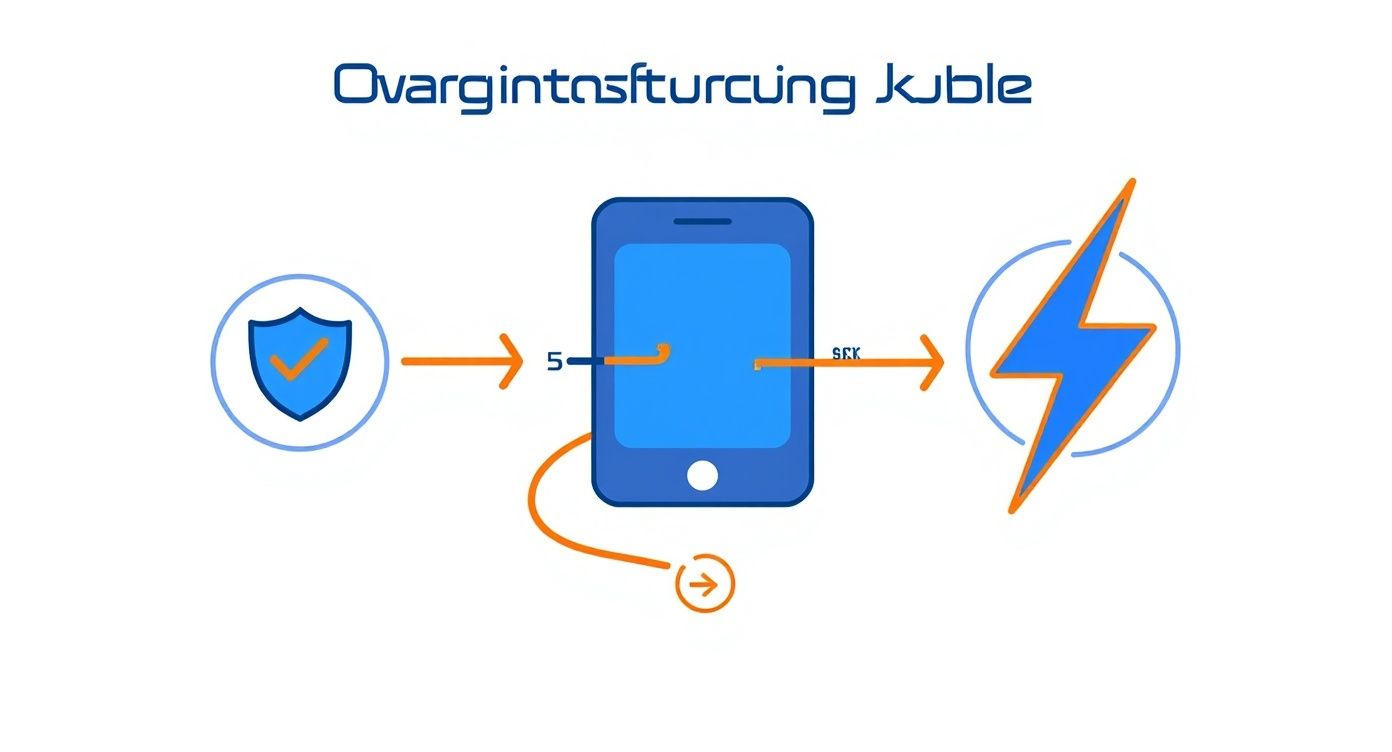
This diagram shows the key things at play when you charge overnight—stress, wear, and safety—which all affect your battery's long-term health.

A conceptual diagram depicting a secure shield icon connected to a smartphone, which then connects to a lightning bolt icon, symbolizing secure charging.

The image highlights how the long-term stress from sitting at 100% is a main cause of battery wear, something that even modern safety features can't completely solve.

The 20-80 Percent Sweet Spot

So, what's the solution? Battery experts have found a "sweet spot" for keeping these batteries happy. By keeping the charge level between 20% and 80%, you reduce that internal stress and help it stay healthy for much longer.

"A lithium-ion battery doesn't need to be fully charged, nor is it a good idea to do so. In fact, it is better not to fully charge, because a high power level stresses the battery and wears it out in the long run."

Studies show that always charging to 100% every night can reduce a battery’s useful life by as much as 20% in just a couple of years. It's like choosing between a full tank of gas for today's trip or making sure your car's engine runs well for years. By staying out of the extreme ends of the charging range, you give your device a much longer, healthier life. You can even discover more about fire risks from overnight charging and see why battery health is also about safety.

Understanding the Hidden Risks of Heat

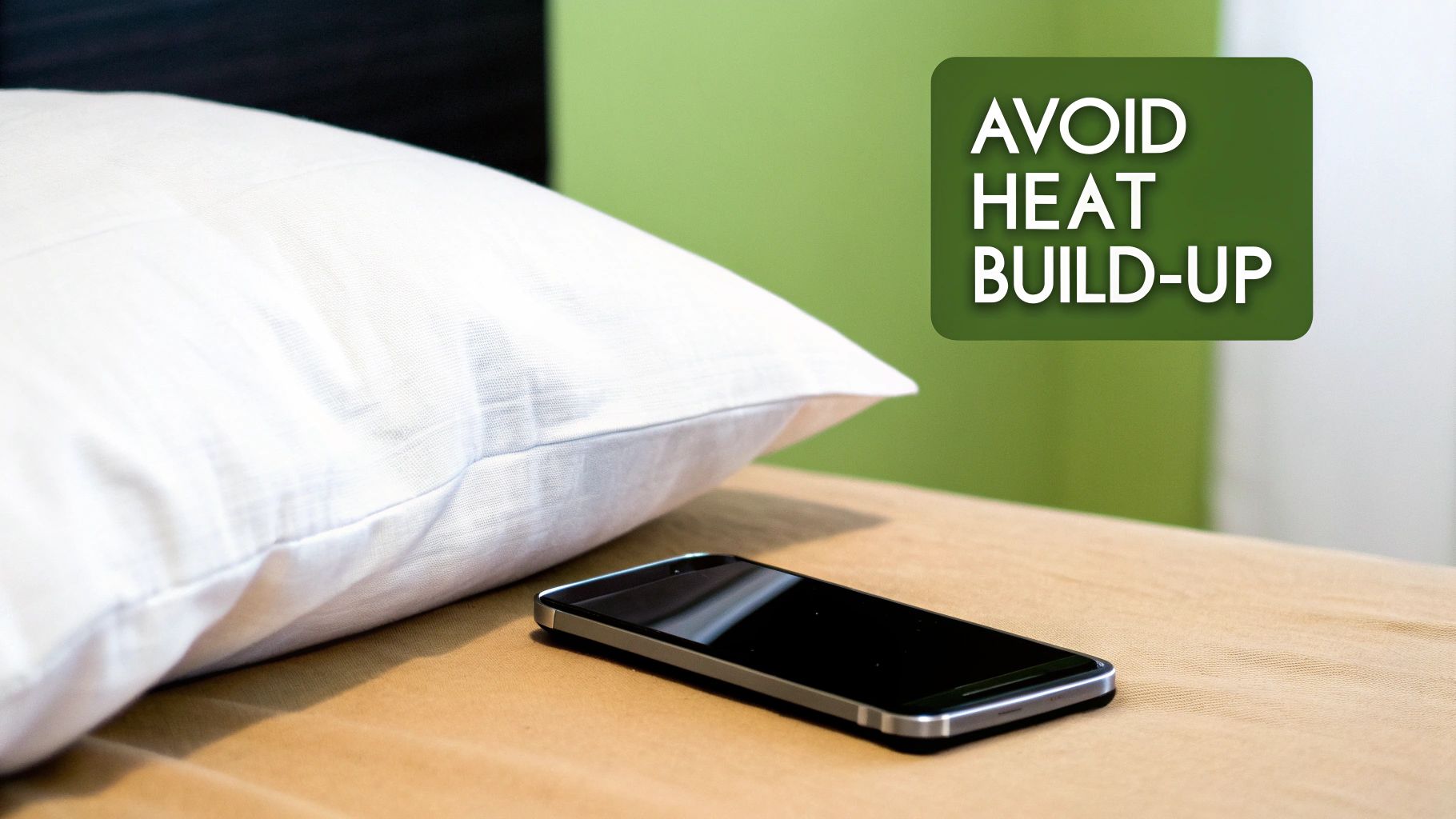
A smartphone resting on a bed next to a white pillow, with a warning to avoid heat build-up.

Besides the slow wear on your battery, leaving your phone plugged in all night brings a more immediate risk that most of us don't think about: heat. Every time you charge, your phone gets a bit warm, but your overnight habits can turn this into a real safety problem.

The trouble starts when that heat can't escape. Tucking your phone under a pillow, leaving it on a soft couch, or letting it get buried under blankets is like wrapping it in a winter coat. These surfaces block airflow, causing heat to build up to dangerous levels.

This trapped heat is bad for two reasons. First, it aggressively speeds up the aging of your battery, making it lose its ability to hold a charge much faster. You can get a deeper understanding of the impact of temperature on lithium-ion cells in our detailed guide on the topic.

From Bad Habit to Real Danger

A dying battery is annoying. But the more serious issue is the risk of fire. This danger becomes very real when people charge their phones in bed—a surprisingly common habit.

Experts warn that charging phones near or under pillows is a fire risk. In the UK, a staggering 74% of people charge their phones in their bedrooms, and about one-third of teenagers admit to sleeping with their phones under their pillows. This common practice greatly increases the danger of the device overheating and possibly catching fire. You can read more about these expert warnings on charging phones in bed.

In these situations, the trapped heat can cause the battery to swell or, in rare but real cases, even catch fire. It's a risk that is simple to avoid but very important to know about.

Why Your Charger Matters So Much

The quality of your charging equipment plays a huge role in your safety. Using certified, high-quality chargers and cables is absolutely necessary for safe overnight charging.

Here’s what makes cheap, knock-off accessories so risky:

  • No Safety Features: Good chargers have built-in parts that watch the temperature and power level, ready to cut the power if things get too hot. Uncertified accessories often skip these crucial safety features to save money.
  • Poor Quality: Low-quality materials can lead to electrical problems or unstable power, which only increases the risk of overheating.

While fires are not common, the chance of one happening is real and completely preventable. The answer to is charging phone overnight bad becomes a definite yes when you mix bad habits with low-quality gear. Always charge your phone on a hard, flat surface where it can get air, and please, buy accessories you can trust.

Smart Charging Solutions You Can Use Tonight

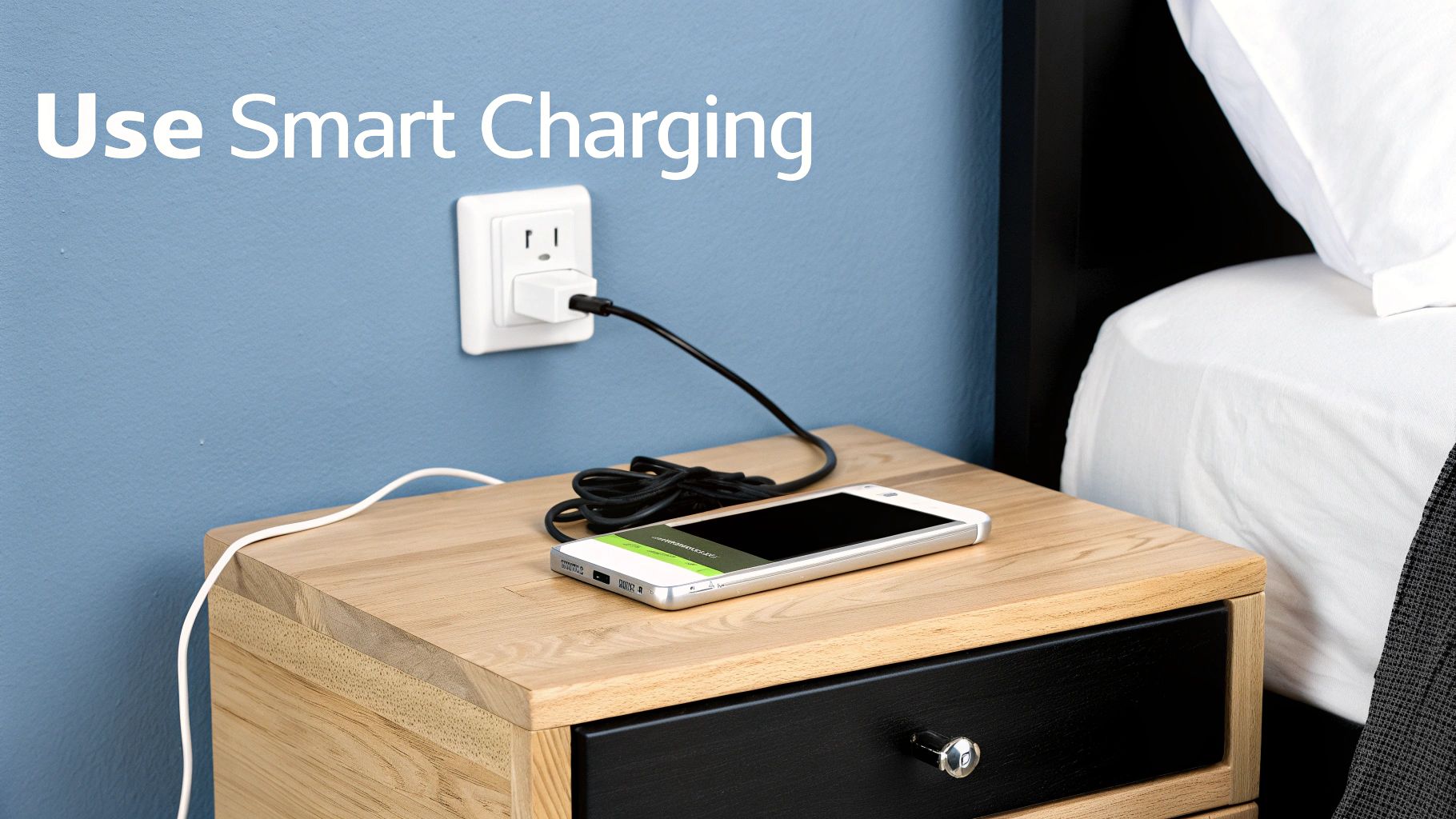
A smartphone is charging on a wooden nightstand, with "Use Smart Charging" text overlay.

Okay, so we've learned that letting your phone sit at 100% charge for hours, especially overnight, isn't great for its long-term health. The mix of high power levels and heat is a recipe for faster battery aging.

But knowing the problem is only half the battle. The good news is that you don't need to be an expert to fix it. Powerful tools are probably already built into your phone, and even better solutions are available for those who want full control.

These features are designed to reduce the time your phone spends in that high-stress, fully charged state. They offer a smarter way to charge.

Your Phone's Built-In Protections

Both Apple and Google have built smart charging features into their phones. Think of these as your phone's automatic defense system against early battery wear.

  • Apple's Optimized Battery Charging: If you have an iPhone, you've likely seen this work. It charges your phone to 80% and then pauses. The software learns your daily routine—like when you usually wake up—and aims to finish the last 20% right before your alarm goes off.
  • Android's Adaptive Charging: Many Android phones, especially Google's Pixel phones, have a similar feature. It uses your alarm settings to time that final charging push, which cuts down the time the battery sits at the stressful 100% mark.

These built-in features are a big step in the right direction. But they have one major drawback: they still push the battery to 100% every single day. While the time spent at 100% is shorter, the peak stress is still there. If you want to learn more about how this software works, we have a detailed guide on what is optimized battery charging.

Taking Control with a Hardware Limiter

For anyone who wants to go beyond the default settings and truly manage their battery's health, a separate hardware device offers a level of control that software alone can't match. This is where a little device like Chargie comes in, acting as a smart gatekeeper between your charger and your phone.

A hardware limiter gives you the power to set a specific charging limit—say, 80% or 85%. Once your phone hits that target, the device physically cuts the power. It completely stops your phone from ever reaching that high-stress state overnight.

This approach gives you a much safer strategy. It's like telling your charger, "Stop right here," ensuring your battery stays in its healthiest, low-stress comfort zone all night, every night.

It’s one thing to talk about it, but another to see it in action. Below is a simple table comparing the different approaches.

Comparing Smart Charging Methods

Method How It Works Level of Control Best For
Built-in Software Learns your routine and delays the final charge to 100% until just before you wake up. Low (Automatic) Casual users who want a simple, automatic improvement over regular charging.
Chargie (Hardware) You set a precise charge limit (e.g., 80%). The device physically cuts power when the limit is reached. High (You decide) Tech fans, business managers, or anyone wanting the longest possible battery life and total control.

While the built-in software is a great start, a hardware limiter like Chargie puts the power back in your hands. You make the rules.

By setting a hard limit, you remove all the guesswork. You're no longer just reducing the time at 100%—you're preventing it from happening at all during those long, idle overnight hours. This is the key to truly preserving your battery for the long haul.

How Businesses Can Protect Their Device Fleets

A dying phone battery isn't just a personal problem—for a business, it's a serious issue that costs time and money. Think about it: companies rely on lots of devices for everything from delivery scanners to employee smartphones. When those batteries start failing, it’s more than just an inconvenience.

A dead device during a shift means work stops. The costs of constantly buying new devices add up. Worse, a device failing at a critical moment can create safety issues for employees who need them to communicate. Suddenly, the question "is charging my phone overnight bad?" becomes a crucial business decision about protecting equipment and keeping things running smoothly.

Central Control for Better Battery Health

Realistically, you can't just ask hundreds of employees to manage their charging habits. It's impossible without a central system. That’s where a proper management solution comes in, letting an administrator set charging rules for every company device from one place.

This is exactly what the Chargie fleet system was built for. It gives businesses control, allowing them to apply universal charging policies like:

  • Setting a Maximum Charge Limit: You can make all devices automatically stop charging at a healthier level, like 85%, which prevents the high-stress state that ruins battery life.
  • Scheduling Charging Times: You can ensure devices only charge when they need to, avoiding all those unnecessary hours spent plugged in and getting hot.

For businesses that rely on these devices, even simple tasks matter. A good iPhone screenshot guide, for instance, can be a useful tool for employee training and support, making device management easier.

A Clear Return on Investment

Using a smart charging system for your company devices isn't just an expense; it's an investment that pays for itself. By making each device's battery last much longer, companies can cut down on replacement costs and delay expensive upgrades.

The image below shows the Chargie fleet management dashboard, where a manager can see and control the charging status of every connected device.

This overview makes it easy for managers to confirm that charging rules are being followed and to spot any devices with battery trouble before they cause a problem.

By taking control of battery health, businesses do more than just save money. They reduce wasted time and make their entire operation more efficient. It turns battery care from a forgotten task into an automated and cost-saving business strategy. This approach ensures your technology investments last longer and work more reliably when you need them most.

Your Action Plan for Healthier Phone Charging

Okay, let's put all this information into practice. Here’s a simple plan you can start using tonight to keep your battery healthy and your home safe.

It doesn’t have to be complicated. The secret isn't some crazy technical trick—it's just about forming a few small, consistent habits. And those habits can make a huge difference in how long your battery lasts.

The main idea is simple: avoid leaving your phone at 100% charge for hours, and keep it from getting hot. These two things are the worst for aging your battery too quickly.

A Simple Checklist for Better Charging

Here are the most important things you can do right away:

  • Charge on a Hard, Flat Surface: I can't say this enough—never leave your phone charging on your bed, under a pillow, or on the couch. Soft surfaces trap heat, and heat is the ultimate battery killer. A nightstand or a desk is the perfect spot.

  • Use Certified Chargers and Cables: Always stick with chargers and cables from your phone's maker or a trusted, certified brand. Those cheap, uncertified accessories you find at gas stations often lack the key safety features that protect your phone from overheating. It’s not worth the risk.

  • Don't Aim for 100% Overnight: This is the biggest takeaway. Letting your phone sit at 100% for hours puts the battery under stress. A good first step is to use your phone's built-in optimized charging feature. But for even better results, a hardware device like Chargie can automatically cut the power at a much healthier level, like 80% or 85%. You might be surprised to learn why a 65% charge makes sense for most people's daily use.

By making these small changes, you can easily double your battery's lifespan. The real goal is to make smart charging an easy, automatic part of your daily routine.

Got Questions? We’ve Got Answers.

We’ve covered a lot about battery health, but you might still have a few questions. Let's answer some of the most common ones to clear up any final confusion about charging your phone overnight.

Does Using a Fast Charger Overnight Make It Worse?

Yes, it can. Fast charging is great when you need a quick power boost during the day, but all that speed creates a lot of heat. And as we've learned, heat is one of the worst things for a phone battery.

When you’re plugging in for a long time like overnight, a standard, slower charger is a much better choice. It keeps the temperature down, which means less stress on your battery's internal parts. Think of it as a slow, relaxing meal versus a rushed, stressful one—your battery definitely prefers the first one.

Should I Let My Phone Die Completely Before Charging?

Nope! That's an old myth from the days of older batteries. Modern lithium-ion batteries are actually stressed out by being drained all the way to 0%.

It's much healthier for your phone to get partial charges. The sweet spot, as confirmed by experts, is keeping your phone between 20% and 80%. Letting it die completely is like making your battery run a marathon it wasn't prepared for.

If you remember one thing, make it this: lithium-ion batteries are happiest when they are neither totally full nor totally empty. Avoiding those extremes is the single easiest way to make them last longer.

Is My Phone's Built-In Optimized Charging Feature Enough?

Let's be clear: the optimized charging features on iPhones and Androids are a big improvement. They learn your routine and wait to charge to 100% until right before you wake up.

But here’s the catch—they still push the battery to that high-stress 100% mark every single day. For anyone who is serious about getting the longest possible life from their battery and wants to keep it at a healthier 80% or 85%, the software-only method doesn't offer enough control. You need something more direct.


For total control over your battery's health, Chargie physically cuts the power at whatever level you set, making sure your phone never sits in that high-stress zone overnight. Take back control of your charging routine at https://chargie.org.

What Is Optimized Battery Charging & How It Works

Optimized battery charging is a feature that protects your phone's battery. It's smart about how it charges, especially when you plug it in overnight. Instead of rushing to 100% and staying there for hours, it pauses the charging around 80%. Then, it finishes charging to full just before you usually wake up. This simple trick helps your battery last much longer.

What Is Optimized Battery Charging and How Does It Work?

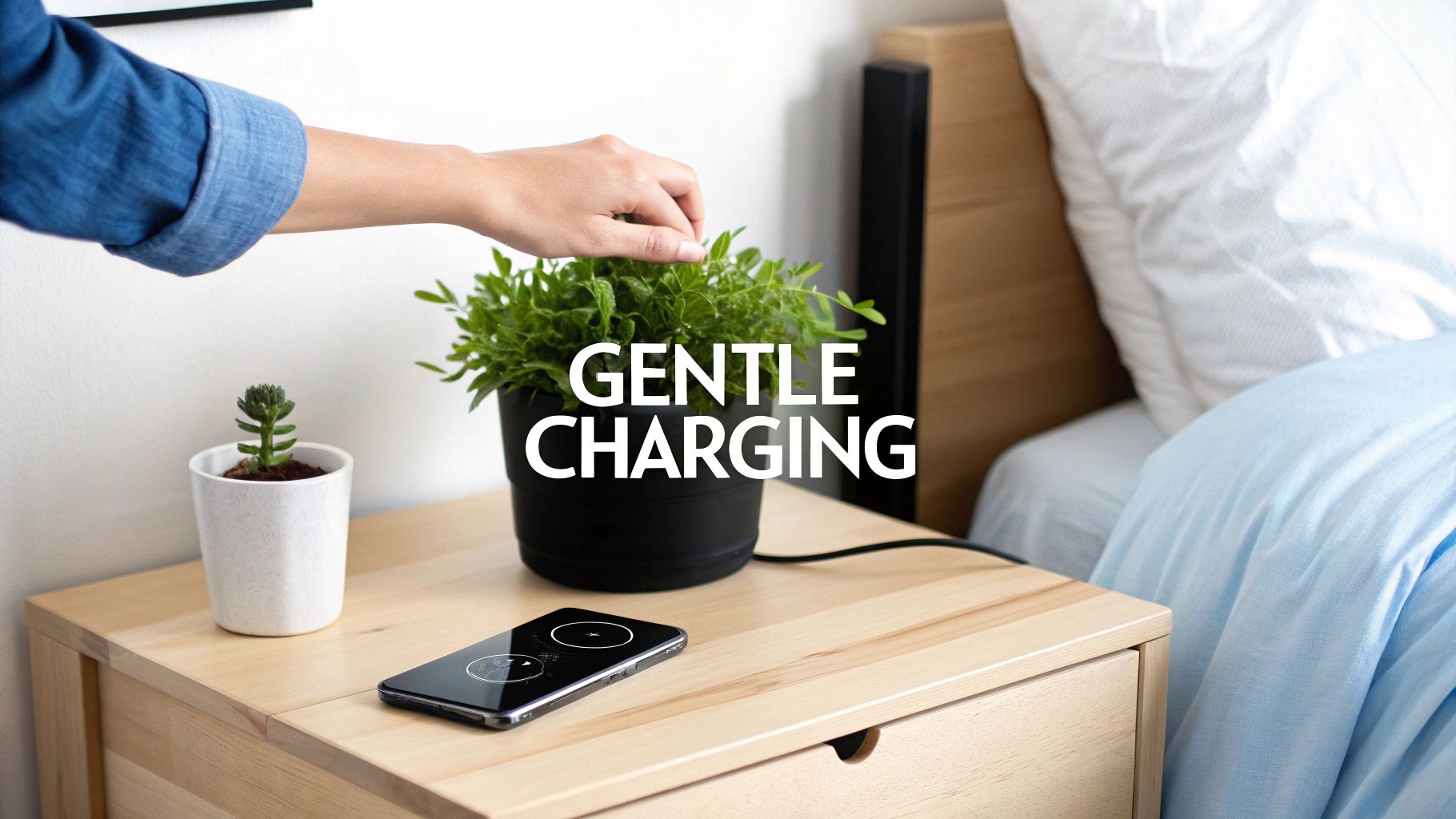
A person touches a plant while a smartphone wirelessly charges on a bedside table, promoting gentle charging.

Think of your phone’s battery like a muscle. If you hold a heavy weight for hours, your muscle gets tired and strained. Leaving your phone's battery at a full 100% charge does something similar—it puts the battery under constant stress, causing it to wear out much faster.

Optimized battery charging acts like a personal trainer for your phone. It learns your daily habits, especially when you plug it in for the night and when you grab it in the morning.

The 80% Rule

The secret behind this technology is avoiding the most stressful part of charging. For the batteries in our phones, that final push from 80% to 100% creates the most heat and strain.

Optimized charging avoids this by pausing at the 80% mark for most of the night. This lets the battery rest in a comfortable, low-stress state for hours. Then, based on your morning routine, it figures out the perfect time to start charging again, making sure it hits 100% right as your alarm goes off.

To give you a quick idea, here’s how normal charging compares to this smarter method.

Standard Charging vs Optimized Charging At A Glance

This table shows the main differences between just plugging your phone in and letting it charge smartly.

Feature Standard Charging Optimized Battery Charging
Charging Goal Reach 100% as fast as possible. Make the battery last longer.
Overnight Behavior Stays at 100% for hours, causing stress. Pauses at 80% and finishes just before you wake up.
Heat Generated Higher, especially during the last 20%. Lower, because charging is managed and timed.
Battery Lifespan Wears out faster due to long-term stress. Slows down aging, making the battery last longer.

Basically, optimized charging trades a little bit of speed for a lot more battery life.

Optimized battery charging is a protective step. It doesn't charge your phone faster; it charges it smarter to keep it healthy and extend its overall life.

This kind of smart technology is becoming more important. The demand for solutions that make our devices last longer is clear. The global market for battery chargers, including these smart systems, was valued at USD 26.9 billion in 2024. It's expected to grow to USD 39.8 billion by 2033, which shows how much people want to protect their devices. You can learn more about the growing battery charger market on imarcgroup.com.

The Main Goals of Smart Charging

At its heart, this smart approach has a few key goals:

  • Spending Less Time at 100%: It greatly reduces the time your battery spends at its most stressful, fully charged state.
  • Creating Less Heat: Slower, more careful charging for the final stage makes less heat, which is a big enemy of battery health.
  • Slowing Down Battery Aging: By handling both high-charge stress and extra heat, it slows down the natural breakdown inside the battery.

So, what is optimized battery charging? It’s a simple, automatic system built to make your battery last a lot longer—all without you having to do anything.

Understanding Why Your Phone Battery Wears Out

Have you ever noticed how a new rubber band is super stretchy, but after you use it a lot, it gets a little saggy? It loses its springiness. Your phone’s battery goes through a similar process, slowly losing its ability to hold a strong charge with every use.

This slow decline is a totally normal process called aging. It happens to every battery in the world. But here's the catch: some of our daily habits can speed up this process. Figuring out those habits is the first step to understanding why a smarter way of charging is so important.

The Main Things That Age Your Battery

Three things are especially bad for your battery's health. Each one puts a lot of strain on the sensitive parts inside, causing it to wear out way faster than it should.

  • Too Much Heat: Heat is the absolute worst enemy. Leaving your phone on a hot car dashboard or playing a demanding game while it's plugged in creates heat that messes up the battery's insides. That damage is permanent.

  • High-Charge Stress: Keeping your battery at 100% is like holding that rubber band stretched to its limit for hours. This high-charge state puts a ton of strain on the battery’s parts, leading to much faster wear and tear. Plugging it in overnight is the most common way this happens.

  • Running it Down to 0%: On the other hand, constantly letting your battery die is also a bad idea. Draining it completely can make the battery unstable, shortening its total lifespan.

Often, these problems happen together. Think about fast-charging your phone all the way to 100%. That creates both high heat and high-charge stress, creating a perfect storm for early battery aging. You can learn more about these factors that influence phone battery life on chargie.org.

Why Charge Cycles Aren't the Whole Story

You’ve probably heard that phone batteries are good for a certain number of "charge cycles"—usually around 500. A single cycle is counted every time you use up 100% of the battery's power. That could be one long use from 100% down to 0%, or it could be two separate uses, like going from 75% down to 25% twice.

But here’s the thing: it’s not just about the number of cycles, but how you use them.

A battery that lives its life mostly between 20% and 80% will last much longer than one that’s constantly pushed from 100% all the way down to 0%. The real damage comes from the stress of hitting those high and low extremes.

This is exactly where the idea of optimized battery charging comes in. It’s all about smartly managing those cycles by avoiding the most damaging levels of charge. By simply keeping the battery out of that high-stress zone above 80% for long periods, you can seriously slow down the aging process.

In the end, your daily charging habits have a direct and powerful impact on how long your phone’s battery stays useful. By avoiding the big three—heat, high charge, and running it to zero—you can keep it healthy and get a lot more life out of your device.

How Optimized Charging Works: Software vs. Hardware

When we talk about "optimized charging," we're not talking about one single thing. It’s a clever strategy that comes in two main types.

The first, and most common, is the software approach that’s already built into your phone. Think of it as a quiet guardian inside your phone's system, making smart decisions about how and when to fill up your battery.

The second approach uses an external hardware device—a physical gadget that manages the flow of electricity. This gives you much more direct, hands-on control. Both methods have the same goal—to slow down battery aging—but they get there in different ways.

The Software Approach: Learning Your Routine

Built-in features like Apple’s Optimized Battery Charging and Android’s Adaptive Charging are perfect examples of the software method. These systems work by watching your daily habits. They learn when you usually go to bed, when your alarm goes off, and when you grab your phone to start the day.

Using this information, the software makes a smart guess. For instance, if you plug in at 11 PM and your alarm is set for 7 AM, it will quickly charge your battery to 80% and then pause. It holds the charge at this "happy" level for most of the night, only starting again to top it off to a full 100% just before you wake up. To get this timing right, many of these systems use tools like predictive analytics to guess what you'll do next.

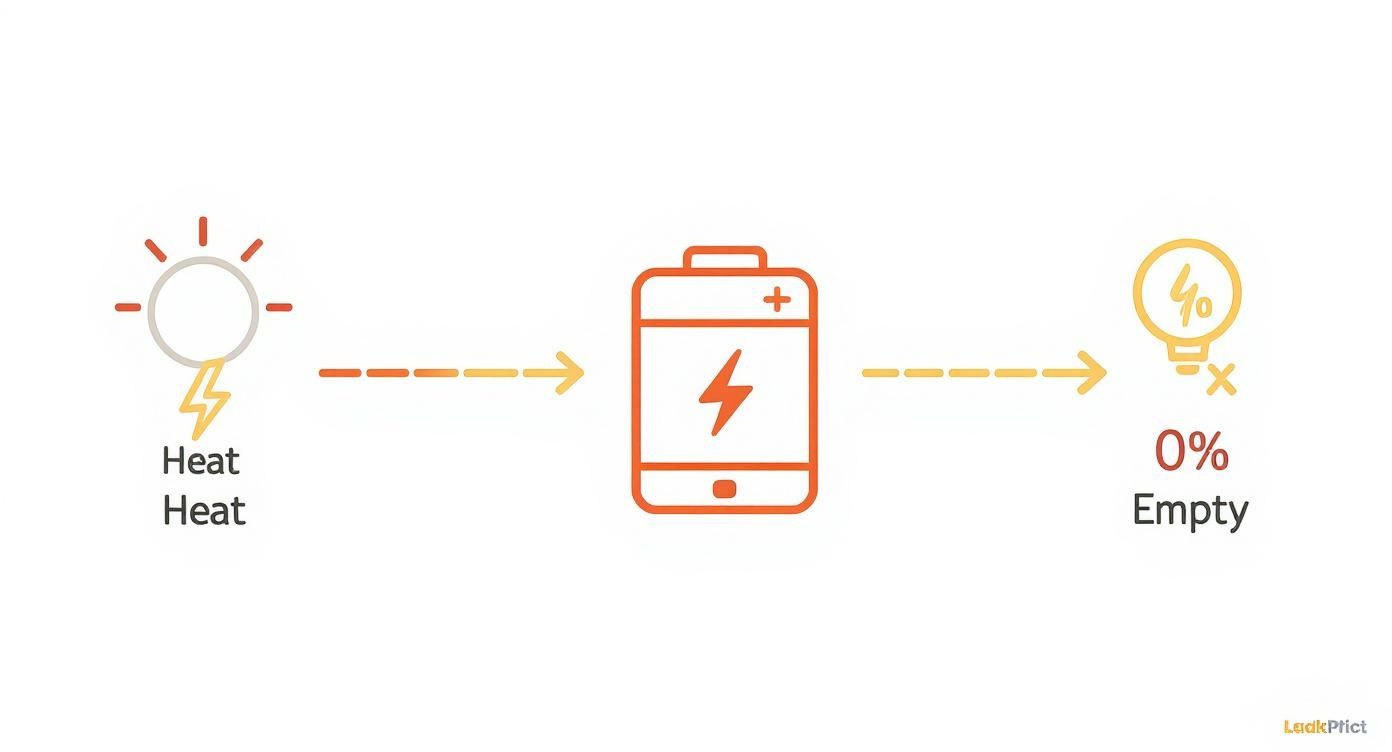
This is all designed to fight the main battery killers: heat, sitting at a full charge, and being completely empty.

Diagram illustrates heat energy affecting a battery, leading to a 0% empty and discharged state.

As you can see, the whole point is to keep the battery out of these high-stress states for as long as possible. That’s the key to its long-term health.

The Hardware Approach: Taking Direct Control

While the software approach is smart and easy, it has one big limit: it’s all based on guesses, and it can’t physically stop the electricity. It just asks the charger to stop. This is where hardware solutions like Chargie come in. A hardware device acts like a smart gatekeeper between your charger and your phone, giving you exact, direct command over the power.

Instead of your phone’s software politely asking for a pause, a hardware device simply cuts the power once a limit you’ve set is reached. No questions asked. This offers a much more reliable and guaranteed way to prevent your battery from sitting at 100%.

Software makes suggestions based on routines, but hardware enforces rules. A physical battery charge limiter provides a definite stop to the charging process, offering a level of protection that software alone cannot guarantee.

This direct control is incredibly powerful. You can set a strict limit—say, 85%—and the hardware will ensure your device never goes over, no matter your routine or how long you leave it plugged in. It puts you back in charge.

A Deeper Look Into Hardware-Based Solutions

While the optimized charging features built into your phone are a good first step, they’re more like a polite suggestion than a strict rule. They rely on learning your habits, which is clever, but not always perfect. When you want absolute, rock-solid control over your battery's health, nothing beats a physical hardware solution.

Let's look at a real-world example like Chargie. Instead of software simply asking the battery to stop taking power, a hardware limiter acts like a physical switch on the power cord. Once your battery hits the charge level you’ve set, the hardware simply cuts the electricity. It's a complete stop.

It’s the difference between asking the power to stop and literally turning off the faucet. This gives you a level of accuracy and reliability that software alone can't ever quite match.

Setting Firm Charging Limits

One of the most powerful things a hardware solution lets you do is set firm charging limits. Imagine drawing a "do not fill past this line" mark on your battery. You get to decide exactly how full it gets—whether that’s 80%, 85%, or another level that keeps it out of the high-stress zone where batteries age the fastest.

Once you pick a limit in the app, the hardware takes over. It watches the charge level, and the moment it hits your target, it completely disconnects the power from the charger. This simple but incredibly effective action prevents your battery from ever sitting at a damaging 100% for hours, no matter how long you leave it plugged in.

Hardware-based charging limits provide a guaranteed stop. They enforce your charging rules by physically cutting the power, ensuring the battery never goes above the safe, low-stress levels you set.

This kind of control is key if you're serious about managing battery health. If you want to dive deeper into the tech that makes this possible, you can learn more about what a Battery Management System (BMS) is and why it matters.

Using a Smart Top-Up Scheduler

The other huge advantage of a hardware system is smart scheduling that works around your life without hurting your battery. Chargie’s Top-Up Scheduler, for example, is like a smart alarm clock for your battery.

You can set it to hold your phone at a healthy, low-stress level (say, 60%) for most of the night. Then, you just tell it what time you need a full charge. The system does the math and figures out the perfect moment to start charging again, making sure your phone hits 100% right as you're about to wake up.

This approach gives you the best of both worlds:

  • Maximum Protection: The battery spends most of the night relaxing in a safe, non-stressful state.
  • Total Convenience: You still wake up to a fully charged phone, ready for the day.

It completely gets rid of the hours of damaging "trickle charging" that happens when a phone stays plugged in all night after it's already full. This kind of just-in-time power management is what makes hardware-based optimized charging so effective. By physically controlling the flow of electricity, it gives you a much deeper layer of protection and the final say over your device's long-term health.

To make it even clearer, let's look at how Chargie’s key features help your battery.

Chargie's Key Features And Their Benefits

Chargie Feature What It Does (Simple Explanation) Main Benefit
Charging Limits Lets you set a maximum charge level (e.g., 80%) and physically stops power when it's reached. Prevents high-charge stress, which is a major cause of battery aging.
Top-Up Scheduler Charges to a safe level overnight (e.g., 60%) then tops up to 100% just before you wake up. Reduces time spent at 100%, avoiding hours of damaging trickle charging.
Smart Pause & Resume Allows a small, natural drop in charge (e.g., from 80% to 77%) before starting to charge again. Stops the constant, tiny "mini-charges" that wear out the battery when left plugged in.
Physical Power Cut-off The hardware itself disconnects the electricity, it doesn't just rely on software commands. Provides a 100% reliable, guaranteed way to enforce your charging rules.

Ultimately, each feature is designed to fight a specific cause of battery wear, giving you a complete system for preserving your device's lifespan.

Where Optimized Charging Really Shines

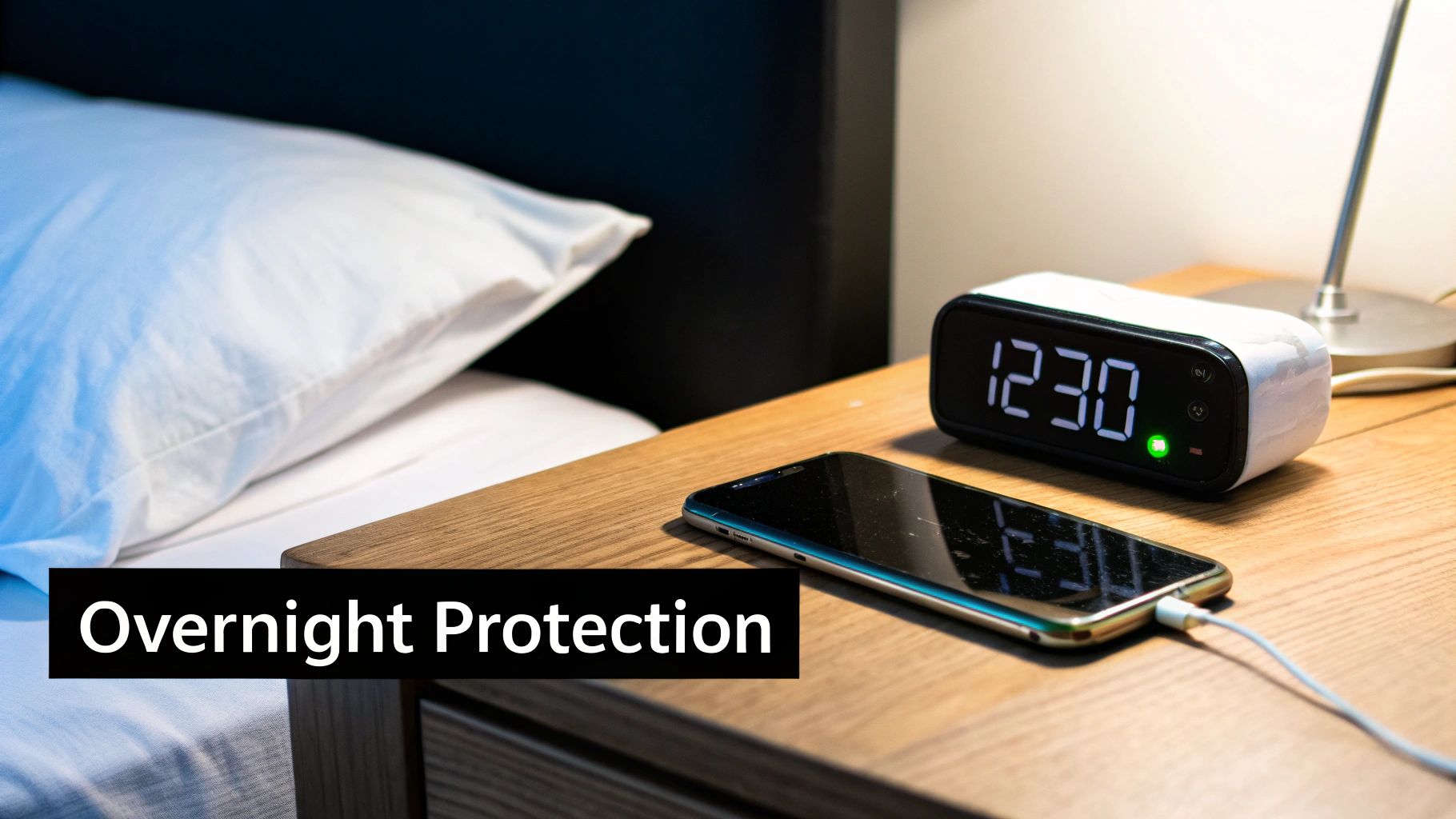
A bedside table with a digital clock showing 12:30, a smartphone charging, and a white pillow.

The idea behind all this is solid, but where does it actually make a difference in our daily lives?

The most common example is something millions of us do every single night: overnight charging. We plug our phones in before bed and don't touch them again for seven or eight hours. That's a long time for a battery to be under stress.

Instead of letting the phone sit at a damaging 100% all night long, an optimized system steps in. It keeps the battery in a much safer, low-stress state for most of that time, preventing the slow damage that kills batteries early. You wake up to a full charge, but without having quietly harmed your device for hours.

Beyond the Bedside Table

But this goes way beyond just our personal smartphones. Think about all the devices in our lives that are always plugged in. These are perfect for optimized charging, since they're constantly being stressed at a high charge level.

  • Home Hubs and Smart Displays: Those tablets or smart screens that act as the brain for your smart home? They're always on and always charging.
  • Retail and Kiosk Systems: Point-of-sale tablets in a coffee shop or self-service kiosks at the airport are plugged in 24/7. Their batteries need help.
  • Fleet and Delivery Vehicles: The phones and tablets used for navigation in company vehicles are constantly plugged into a power source, leading to short device lifespans and high replacement costs for businesses.

For every one of these, optimized battery charging is a practical tool that turns a disposable item into a long-lasting one. It saves money and cuts down on electronic waste. By preventing these always-on devices from sitting at 100%, you can greatly extend their useful life. A hardware limiter with a feature like Chargie's new top up scheduler is a perfect fix for these situations.

Powering the Future of Transportation

The rules of optimized charging are most important in the electric vehicle (EV) world. An EV's battery isn't just another part; it's the heart of the vehicle, affecting its range, performance, and how much it's worth later.

The global shift to EVs makes this clear. In 2023, nearly 14 million electric vehicles were sold worldwide, making up 18% of total car sales. These numbers show just how important battery life has become in the car world. You can dig deeper into the rise of battery management systems on grandviewresearch.com.

Just like your phone, leaving an EV plugged in at 100% for long periods can seriously damage its expensive battery. That’s why smart charging systems in EVs often let owners set a charging limit—usually around 80%—for daily driving, saving a full charge only for long road trips.

This single strategy protects the most valuable part of the car.

From the phone in your pocket to the EV in your driveway, optimized charging isn't a gimmick. It’s a key technology for a more sustainable electronic future.

Got Questions About Optimized Charging? Let's Clear Things Up.

Even after you get the main idea of what optimized battery charging is, a few practical questions always seem to pop up. That's totally normal. We're talking about changing a habit as old as the smartphone itself—plugging it in and forgetting about it.

So, let's clear up the confusion and answer some of the most common questions people have. My goal is to explain how all this works in the real world so you can feel confident you're doing the right thing for your phone's battery.

Should I Just Leave Optimized Charging On All the Time?

For most of us, the answer is a big, loud yes. The whole point is to slow down battery aging, and who doesn't want that? If you have a fairly regular daily routine, and especially if you charge your phone overnight, leaving the feature on is an easy choice. You get serious long-term protection without doing a thing.

But there are exceptions. If your schedule is unpredictable or you often need to charge your phone as fast as possible, you might want to turn it off sometimes. For everyday, normal use, though? Keeping it on is the smartest move for your battery's health.

Is This Going to Make My Phone Charge Slower When I’m in a Rush?

This is probably the biggest worry people have, but you can relax. The answer is almost always no. Optimized charging is smart enough to know when to slow down. It's designed to turn on during those long, predictable charging times, like when you plug in before bed.

If you plug your phone in for a quick top-up in the middle of the afternoon, the system is clever enough to know this isn't a long charging session. It will let the power flow at the fastest speed your phone and charger can handle.

Optimized battery charging doesn't just slow down every charge. It specifically targets those long, idle periods where your battery would otherwise sit at a stressful 100% for hours.

This really gives you the best of both worlds: gentle, protective charging when it makes sense, and full-speed power when you're in a hurry.

Does It Matter What Kind of Charger I Use?

Nope! The software-based optimized charging built into your iPhone or Android phone works with pretty much any standard charger and cable. All the smarts are happening inside the phone's software; the phone itself is making the decisions, not the charger.

Now, when you use a hardware-based solution like Chargie, you get even more freedom and control. It works with any device that charges over USB, which is a lifesaver for gadgets that don't have a fancy built-in software feature. It gives you direct, physical control over the flow of electricity, no matter what charger you're using.


Ready to take real control over your device's long-term health? The Chargie hardware limiter gives you the power to set precise charging limits, schedule top-ups, and physically stop battery-damaging overcharging in its tracks. Extend your battery's life and cut down on e-waste by visiting https://chargie.org to get yours today.
What Is a Battery Charge Limiter and How Does It Work

Ever feel like your phone's battery life just falls off a cliff after a year? You're not imagining it. A battery charge limiter is a simple tool designed to stop that from happening, and it works by preventing your phone from charging all the way to 100%.

It might sound strange, but this one small change can dramatically extend your battery's long-term health and keep it performing like new for years, not months. It works by cutting down on the hidden stress that slowly kills batteries over time.

The Hidden Stress That's Degrading Your Phone Battery

A smartphone connected to a charger with a battery icon displayed on the screen.

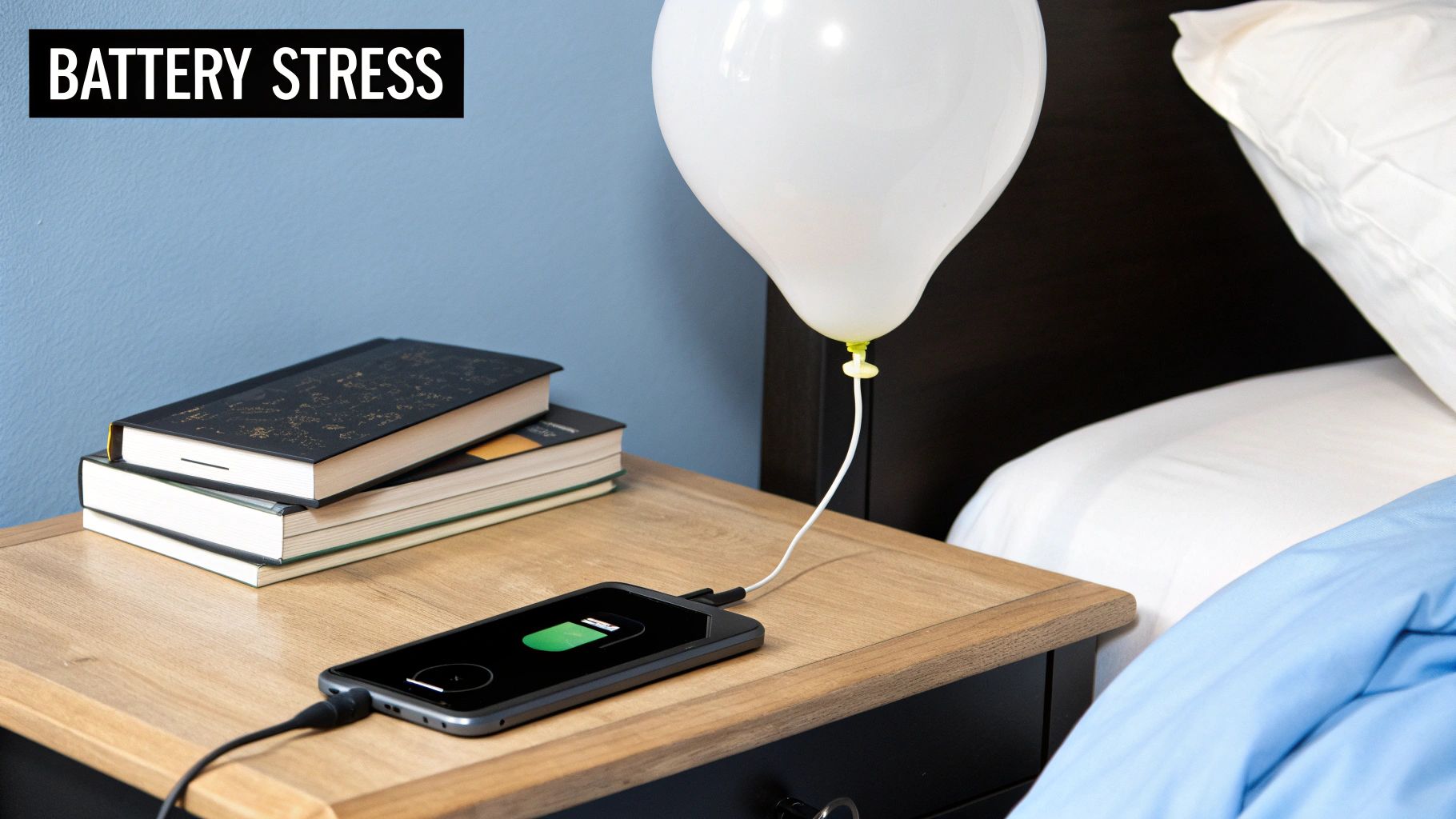
Think of your phone’s battery like a balloon. Every time you charge it to 100%, you're stretching that balloon to its absolute maximum. Leaving it plugged in overnight is like holding it fully stretched for hours.

That constant tension puts a lot of stress on the battery's insides. This is the real reason batteries get old—it permanently damages them, reducing their ability to hold a charge.

Finding the Charging Sweet Spot

If you look at how a battery charges, the real damage happens in that final stretch from 80% to 100%. Pushing the battery into this high-stress state is like revving a car's engine into the red zone; it causes a ton of unnecessary wear and tear.

Simply avoiding this high-stress zone can drastically slow down the aging process. For most people, the "sweet spot" for daily charging is right around 80%. This gives you more than enough power for the day while avoiding the worst of the damage.

A battery charge limiter acts as a bodyguard for your device's long-term health. It ensures the battery stays in a healthier, lower-stress state, preserving its ability to hold a charge for years instead of months.

To put it in perspective, here’s a quick look at how different charge levels can impact your battery’s lifespan.

How Charge Levels Impact Battery Health

Maximum Charge Level Relative Stress on Battery Estimated Lifespan Improvement
100% Very High Baseline (standard lifespan)
90% High Up to 2x longer life
80% Moderate Up to 4x longer life
70% Low Up to 8x longer life

As you can see, even small changes can make a huge difference. You don't have to be perfect, but regularly stopping the charge before it hits the top can multiply your battery's useful life.

The Broader Impact of Smart Charging

This isn't just about phones. The idea of limiting a charge is a key part of bigger battery management systems (BMS), which are vital for everything from laptops to electric cars.

In fact, the BMS market is expected to grow from USD 9.84 billion in 2025 to USD 46.47 billion by 2033. That huge growth, as noted by Straits Research, shows just how important smart battery care has become. These systems are designed to keep batteries from working outside their safe limits, protecting both their lifespan and your safety.

Ultimately, managing how your device charges is about more than convenience. It’s about protecting your investment and making sure you have a reliable device when you need it. Of course, other factors like high temperatures and super-fast charging also play a big role, which you can learn about in our detailed guide on battery degradation.

How a Battery Charge Limiter Protects Your Device

A person setting a battery charge limit on their smartphone.

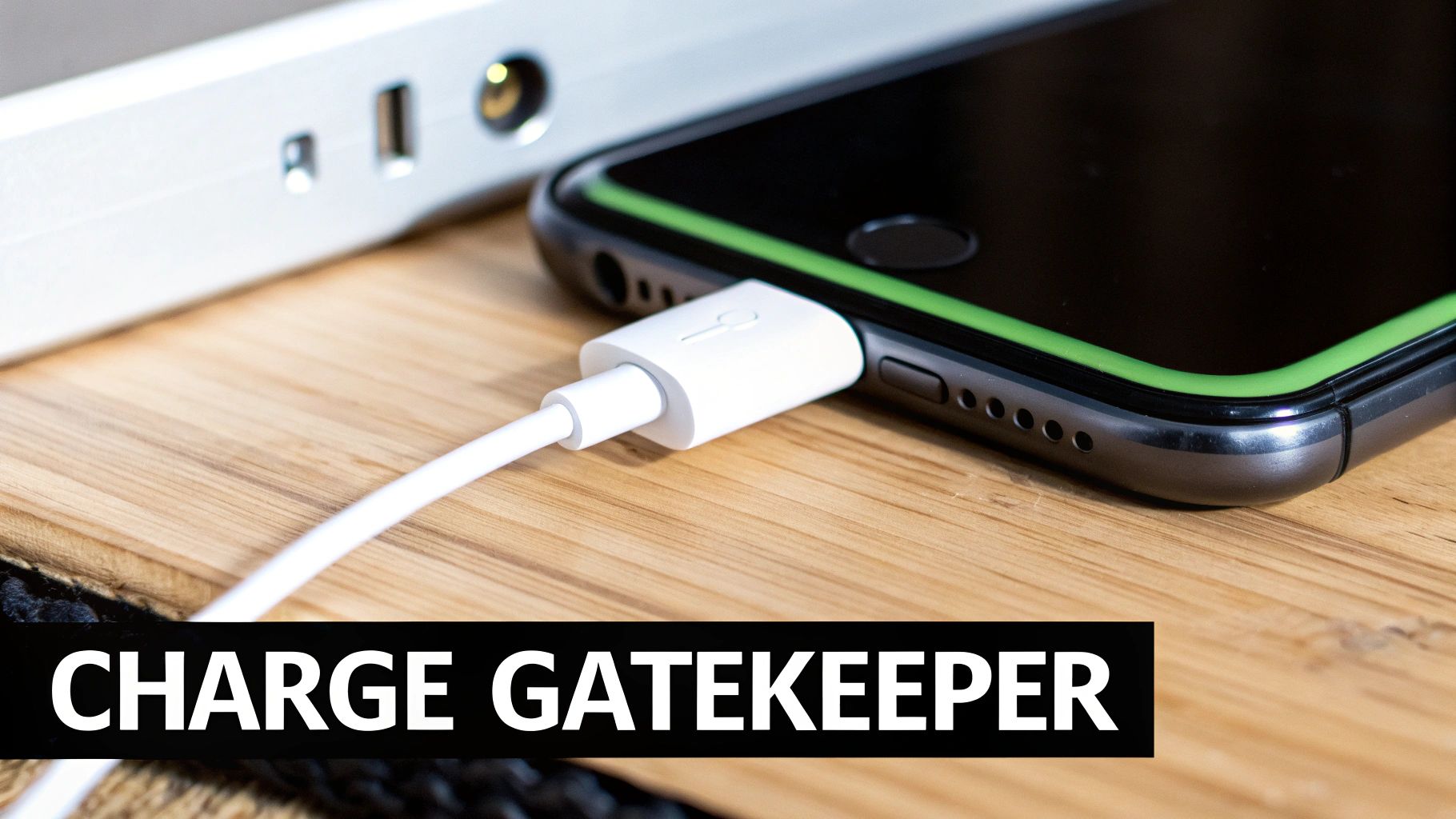
So, how does a battery charge limiter actually work its magic? Think of it like a smart gatekeeper for your phone or laptop’s battery. Instead of just letting electricity flood in until the battery is full, this gatekeeper stands guard.

While your device is plugged in, the limiter keeps a close eye on the battery level. Once it hits the target you’ve set—say, 80%—it steps in and tells the charger to cut the power. That’s it.

This one simple move is the secret to long-term battery health. It keeps your device out of that high-stress zone between 80% and 100%, which is especially damaging during long overnight charging sessions where a battery can sit at full capacity for hours.

Two Main Types of Limiters

You’ll generally find two different ways to use this battery-saving strategy. Knowing the difference will help you figure out what's best for you.

  • Software-Based Limiters: These are features you see built into some newer gadgets. They're convenient since there's nothing extra to buy, but they’re often a one-size-fits-all solution, usually stuck at an 80% limit with no way for you to make adjustments.
  • External Hardware Limiters: This is a physical device that sits between your charger and your charging cable. It’s a much more powerful and flexible approach, giving you full control over the charging process, completely separate from your device's software.

By creating a hard stop for the electricity, a battery charge limiter dramatically reduces the wear and tear on the battery. This small step can multiply your battery’s effective lifespan, preserving its ability to hold a charge for years.

How It Prevents Damage

Every time your battery charges all the way to 100%, the high electrical pressure puts a ton of strain on its internal parts. Do this over and over, and you cause permanent damage. The battery just can't hold as much power as it did when it was new. It's exactly why a two-year-old phone can barely make it to dinner time.

A battery charge limiter tackles this problem head-on. By keeping the charge in a healthier, less-stressed range, it minimizes that high-pressure punishment. You can think of it as giving your battery some breathing room, letting it operate in a relaxed state instead of a stressed-out one. When looking into common battery issues, it’s worth exploring practical solutions for gaming laptop battery life problems and other high-demand devices, where this principle is a game-changer.

This proactive care means your battery holds onto its original capacity for way longer, making sure your device stays reliable and useful for years to come.

Comparing Built-In Software vs Hardware Solutions

When it comes to protecting your battery, not all charge limiters are the same. The two main options are the built-in software features that come with your phone, or a separate hardware device.

Each one has its pros and cons, and understanding the difference is key to picking the right level of protection for your gear.

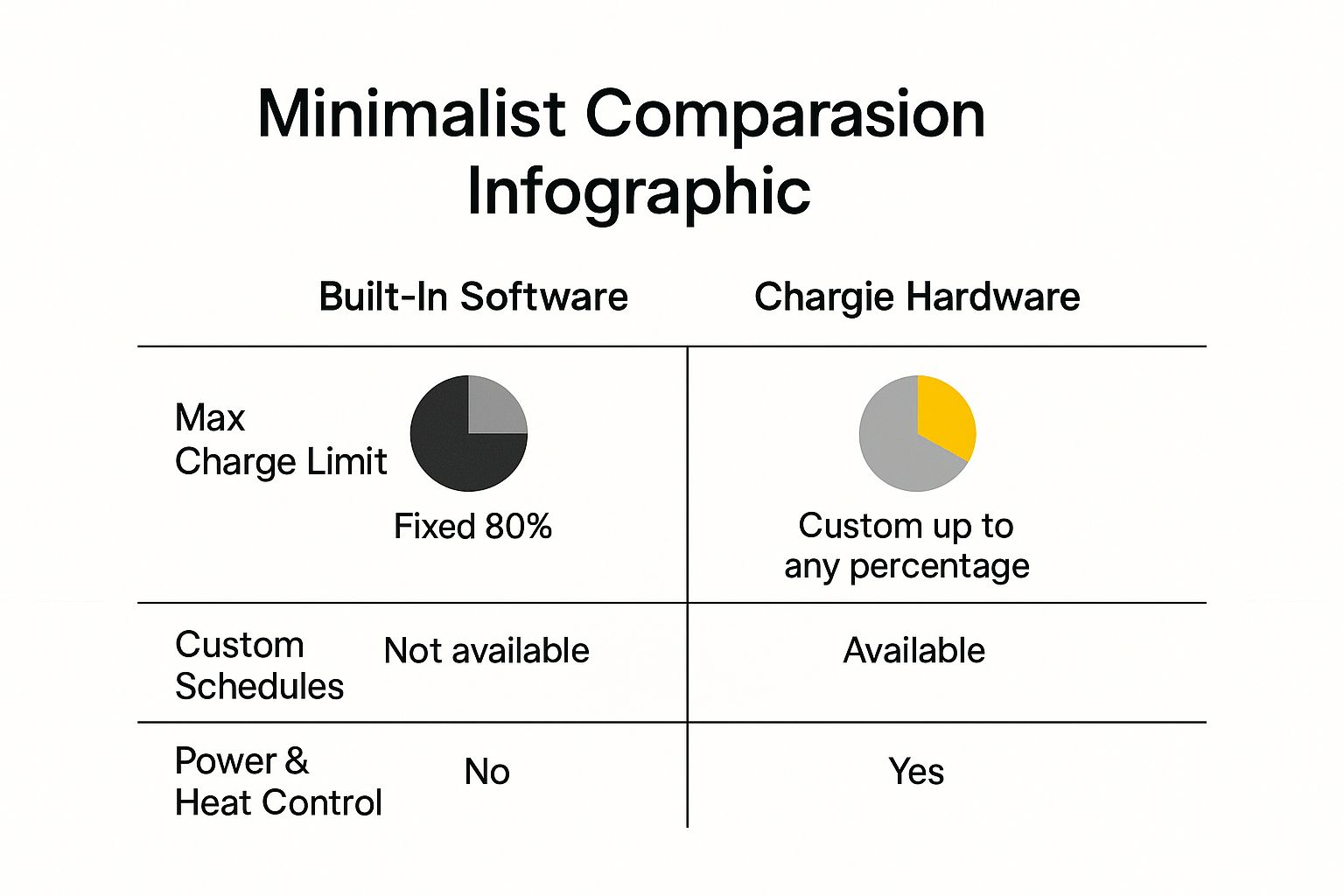
Many newer phones and laptops come with a software-based battery charge limiter built right into the system. You've probably seen it—a simple switch in your settings that stops the charge at 80%. The biggest plus here is convenience. It’s already on your device, and it’s free. No extra purchase needed.

But that simplicity is also its biggest weakness. These built-in tools are a one-size-fits-all solution, offering almost no room to customize. You're stuck with whatever limit the manufacturer decided on, usually 80%, which might not be what you need. If you have a long day ahead and need a full battery, you have to dig into the settings, turn it off, and then—hopefully—remember to turn it back on later.

The Power of Dedicated Hardware

This is where external hardware solutions, like our own Chargie, completely change the game. A hardware battery charge limiter is a small gadget that physically sits between your charger and your phone's cable. Think of it as a smart gatekeeper for your electricity.

This approach gives you a true, physical "hard stop" to the electricity flowing into your battery. It's far more reliable than a software command, which can sometimes fail or get ignored by a system update.

Most importantly, it unlocks a much deeper level of control. Instead of being locked into a rigid 80% limit, you can set the charging cap to any precise level you want, whether that's 85%, 92%, or anything in between.

With hardware, you’re not just limiting the charge; you're taking full command of your battery’s health. This allows for scheduled charging, so your phone can top up to 100% just before you wake up, giving you a full battery without the overnight stress.

The companion app gives you an easy-to-use dashboard for setting these custom rules. From there, you can schedule charging times and set those exact battery level targets with just a few taps.

This level of fine-tuned control is exactly why dedicated hardware is the better choice for anyone serious about long-term battery care. In fact, you can see a detailed breakdown of how Chargie's hardware approach beats Apple's built-in software limiter in our head-to-head comparison.

On top of that, advanced hardware limiters can also reduce the charging power to keep heat down—another silent killer of battery health. This idea of smarter charging is catching on everywhere. The industrial battery charger market is projected to more than double, from USD 2.735 billion in 2025 to USD 6.184 billion by 2035. This massive growth is driven by the demand for smarter tech that preserves battery life. When you look at professional-grade solutions, you see technologies like smart controllers for comprehensive battery management becoming the standard.

Why Chargie Offers Superior Battery Protection

Software-based limiters are a good first step, but they’re a basic tool. When you want serious, smart protection for your battery, you need a hardware solution like Chargie. It's more than just a setting; it's a complete system—a physical device paired with a smart app—that gives you real control over how your devices charge.

Think of the small hardware piece as the muscle. It sits between your charger and your phone, acting as a physical smart switch. It doesn't just ask the phone to stop charging; it physically cuts the power. This is a far more reliable way to do things, ensuring the charge stops exactly when you want it to, every single time.

The app, then, is the brains behind the operation. It tells the hardware what to do, letting you create custom rules that go far beyond a simple 80% limit. This combination of smart hardware and intelligent software is what makes all the difference.

Going Beyond the Basics

With a dedicated hardware limiter, you unlock a whole set of features designed to maximize your battery’s lifespan and make your life easier. These are capabilities that address how people actually use their devices, something a simple software toggle just can't do.

Here’s what you get:

  • Precise Percentage Control: You’re not stuck with the manufacturer's 80% limit. Feel like 82% is the sweet spot for tomorrow? Or maybe 87%? You can set the charging cap to whatever level you want, whenever you want.
  • Intelligent Scheduling: This is where it gets really smart. You can plan your charging so your battery sits in the ideal 50-70% range all night, then automatically tops up to 100% just minutes before your alarm goes off. You wake up to a full battery without putting it through hours of high-level stress.
  • Power and Heat Reduction: Chargie can actually limit the amount of power flowing into your device. Less power means less heat, and since heat is one of the biggest killers of batteries, this adds another powerful layer of protection.

To put it simply, here’s a quick look at how the two approaches stack up.

Feature Comparison: Built-in Limiter vs Chargie

Feature Typical Built-in Software Limiter Chargie Hardware Limiter
Charge Level Control Fixed, usually at 80% Fully customizable (1% to 100%)
Scheduling Basic or non-existent Advanced scheduling with top-up timing
Power Management None Actively limits power draw to reduce heat
Overnight Charging Strategy Stays at 80% all night Can maintain a lower level (e.g., 50%) and top up just before you wake
Method of Control Software request (can be ignored) Physical power cutoff (guaranteed stop)
Device Compatibility Limited to specific phone models Works with virtually any USB-powered device

As you can see, the difference is night and day. One is a basic safety net, while the other is a complete battery care system.

Infographic about battery charge limiter

This visual really drives the point home. A built-in limiter offers one fixed benefit. A hardware solution like Chargie delivers a multi-part strategy for keeping your battery healthy for the long haul.

A Smart Investment, Not a Gadget

At the end of the day, using Chargie isn't about adding another tech gadget to your life. It’s a smart financial decision. By dramatically slowing down how quickly your battery ages, you can avoid costly battery replacements and get more years out of your expensive smartphones, tablets, and laptops.

Chargie pays for itself by preventing the early death of your device's battery. This simple tool ensures your technology performs at its best for years, saving you money and reducing electronic waste.

And this level of protection isn't just for phones. As you can see in our guide on how to use Chargie to future-proof any device's battery, its benefits extend to all your tech. When you invest in proper battery care, your devices stay reliable, perform better, and hold their value for much longer.

What This Means For You in the Real World

Alright, let's move beyond the technical details. What does all this smart charging stuff actually mean for you and your phone in the real world? It's about more than just a healthier battery; it translates into real savings, a phone that just works better, and a lot less stress.

A person smiling while using their smartphone, with a green battery icon in the background indicating good battery health.

The most direct impact is on your wallet. A new battery for a modern smartphone can easily set you back $100 or more. If you have to replace the whole phone, you're talking hundreds. By simply slowing down how fast your battery wears out, you can put off—or even skip—those costs entirely.

Double Your Phone's Lifespan

Think about how often people get new phones. Most of us upgrade every couple of years. It’s usually not because the camera is bad or the phone feels slow; it's because the battery is shot. A phone that’s dead by 3 PM is basically useless.

Now, imagine this instead: by using a battery charge limiter and adopting a smarter charging routine, that same phone could easily give you solid all-day battery life for four, five, or even more years. You're not just saving a part; you're effectively doubling the useful life of a device you spent a lot of money on.

A battery charge limiter transforms your phone from a two-year disposable gadget into a reliable tool you can count on for the long haul.

Better Performance and Day-to-Day Reliability

A healthy battery isn't just about lasting longer between charges. It’s also about delivering power smoothly. As batteries get older and weaker, they struggle to provide steady power, which can cause your phone to feel sluggish or even shut down unexpectedly, especially when you're doing something that uses a lot of energy.

Keep your battery in good shape, and your device will run smoothly for years. This means you can walk out the door with confidence, knowing your phone will make it through the day without you having to hunt for an outlet or carry around a heavy power bank. That kind of reliability is priceless.

A Smarter, Greener Approach to Tech

Finally, let's talk about the bigger picture. Every phone that gets thrown out early adds to the massive global problem of e-waste. By making your gadgets last longer, you’re doing your part to reduce your environmental impact. It's a small change with a big effect.

This same idea is being used in huge ways. For instance, by early 2025, massive battery storage systems made up almost 14% of California's entire power grid. These systems rely on smart charge limiting to stay stable and protect billions in investment. It just goes to show how crucial this technology is, from our pockets to our power plants. You can learn more about how battery storage is shaping our energy future from CAISO reports.

Got Questions About Battery Limiting? Let's Clear Them Up.

Even after seeing how much this helps, it's normal to have a few questions before you jump in. We've all been trained for years to just plug our phones in and leave them until they hit 100%. Breaking that habit can feel a little weird at first.

To clear up any doubts, here are the most common questions people ask, along with simple, straight-up answers to help you feel good about making this battery-saving change.

Is It Really That Bad to Charge My Phone to 100 Percent?

In a word, yes. Now, doing it once won’t kill your battery, but making a habit of charging to 100% and leaving it there is one of the fastest ways to wear it out. The final push from 80% to 100% is where the real stress happens inside the battery.

Think of it like stretching a rubber band all the way to its breaking point and just holding it there for hours. Do that enough times, and it's going to lose its snap and become weak.

By stopping the charge at around 80%, you keep the battery out of that high-stress red zone. It's a small change that makes a huge difference, cutting down on wear and tear and helping your battery hold a healthy, long-lasting charge for years, not months.

Will Using a Charge Limiter Void My Phone's Warranty?

This is a big one, but you can relax. Using an external hardware battery charge limiter like Chargie will absolutely not void your phone's warranty. Not a chance.

These little gadgets are smart, but they don't change anything inside your phone. All they do is manage the power flowing from your charger. Think of it as a smart on/off switch for the electricity.

As far as your phone is concerned, it just sees the charger being unplugged when it hits the right percentage. The limiter doesn't mess with your phone's software, touch its internal hardware, or interfere with how it works at all. It's a completely safe, warranty-friendly way to protect your investment.

"A battery charge limiter works outside of your device's operating system. It simply controls the external power source, making it a safe and universally compatible solution for battery preservation."

Can I Still Get a Full Day's Use If I Only Charge to 80 Percent?

For most people, the answer is a big, resounding "yes." When a phone is new, its battery is at peak performance, and 80% of that is more than enough power to get you through a typical day.

But here’s the real magic behind this strategy: it's all about how it performs over time.

Think about the alternative. Someone who always charges to 100% might find their battery's actual maximum capacity has dropped to just 70% after only a couple of years. At that point, their "full" charge is actually less than the 80% you've been carefully maintaining all along.

Plus, smart tools like Chargie give you the best of both worlds with scheduling. You can let the battery sit at a happy, healthy level overnight, then have it automatically top up to 100% just before your alarm goes off. You get all the battery health benefits and a full tank right when your day starts.


Ready to take back control of your phone's long-term health? The Chargie hardware limiter gives you the power to set exact charging limits, build smart schedules, and seriously extend your battery's lifespan. Stop worrying about degradation and protect your investment by visiting https://chargie.org to grab yours today.

Article created using Outrank

Battery Health: Tips for Maintaining Your Smartphone’s Lifespan

In today’s world, our smartphones are essential companions, helping us stay connected, work efficiently, and unwind with some entertainment. With all this usage, maintaining your smartphone’s battery health in good condition is crucial to ensure your device lasts longer and performs better. Let’s explore some practical tips to help you keep your smartphone’s battery in check for the long haul.

Understanding Battery Health

Your smartphone’s battery will naturally degrade over time, but how you use and care for your phone can significantly impact its longevity. A well-maintained battery ensures your phone stays charged longer, works optimally, and delays the need for a replacement.

Read more “Battery Health: Tips for Maintaining Your Smartphone’s Lifespan”

Chargie is a smart charging device designed to extend the lifespan of your phone's battery by limiting overnight charging.

Company

Lighty Electronics SRL
42 Viorelelor st
305500 Lugoj, Romania

EU VAT: RO35245011

© 2019-2026 Lighty Electronics SRL. All Rights Reserved.

Add to cart