
Clicky

mAh vs Wh: A Simple Guide to Battery Life

When you're trying to figure out which battery pack is best, you'll often see two measurements: mAh and Wh. So, what's the simple answer? Watt-hours (Wh) give you a much better picture of a battery's total energy than milliampere-hours (mAh) ever could. If you want to know how long your device will actually last, Wh is the number to look at.

Why Watt-Hours Are a Better Measure Than mAh

Let's try a simple analogy. Think of a battery like a water bottle. The mAh rating tells you how much water the bottle can hold. But Wh, on the other hand, tells you how long you can actually drink from that bottle, because it also considers the pressure pushing the water out. In battery terms, that "pressure" is its voltage.
Smartphone displaying use watt hours message with battery icons on wooden desk beside laptop

Because Watt-hours include voltage in their calculation, they measure the total energy a battery holds. This makes it the best way to compare any two batteries, no matter what size they are or what device they're for.

The Problem with Only Using mAh

If you only look at mAh, you can easily be misled. For example, a 10,000 mAh power bank for your phone (which runs at 3.7 volts) actually holds less total energy than a smaller 8,000 mAh power bank for a laptop (running at 12 volts). The laptop pack's higher voltage delivers more power, making its lower mAh rating a bit tricky.

Key Takeaway: Watt-hours (Wh) is the true measure of a battery's energy. It combines both capacity (mAh) and voltage (V) to give you a genuine apples-to-apples comparison between any two batteries.

This is exactly why airlines set their battery restrictions in Wh, not mAh. It's the universal language of energy storage. Understanding this difference is also helpful if you're trying to figure out an electric vehicle's real-world mileage, a topic that often comes up in guides for decoding electric scooter range.

Comparing mAh vs Wh at a Glance

To make it even clearer, here’s a simple breakdown of what each unit is really telling you.

Metric What It Measures Best For Analogy
mAh Electrical Charge Comparing batteries with the same voltage. The size of a car's fuel tank.
Wh Total Energy Comparing any two batteries accurately. How far the car can actually drive.

By shifting your focus to Watt-hours, you can make smarter choices and ensure the battery you're buying actually has the power you need for your devices.

Understanding mAh and Its Limitations

When you glance at a battery's specs, the first number you usually see is its capacity in milliampere-hours (mAh). For a long time, this was the main number people looked at. Think of it as a small bucket that holds a certain amount of electricity.

Years ago, this worked just fine. Most smartphones and gadgets ran on batteries with a similar voltage, typically around 3.7V. In that environment, a bigger mAh number meant a longer-lasting device, plain and simple. A 4,000 mAh battery would reliably outlast a 3,000 mAh one because the "pressure" pushing the electricity out—the voltage—was the same.

Why mAh Can Be Misleading Today

But the tech world has changed. Today's devices, from powerful smartphones to beefy power banks and laptops, use all sorts of different voltages. This is where relying only on mAh gets you into trouble.

Comparing two batteries by mAh alone is like trying to figure out which car goes farther by only looking at the size of its gas tank. A huge truck with a 25-gallon tank seems way better than a tiny car with a 10-gallon tank, right? But if the truck gets poor mileage and the car is super-efficient, the smaller car might actually travel much farther on a full tank. Voltage is like that fuel efficiency—it determines how much real work the stored charge can actually do.

The Critical Flaw: Milliampere-hours (mAh) only measure electrical charge, not the total energy stored. Without knowing the voltage, the mAh value is just one piece of the puzzle and can give you a false sense of a battery's true capacity.

The Shift to a Universal Standard

This is exactly why the industry has been shifting to a better, more honest measurement. Back in the early days of portable electronics, mAh was simple and it worked. But as the market filled with devices using different battery types and voltages, Wh became the true global standard because it accounts for those voltage differences. In fact, over 75% of new electronics now list battery capacity in Wh.

Understanding this difference isn't just about nerding out over specs; it's key to taking care of your devices. To really get the most out of every charge and understand the ideas behind maintaining excellent battery health, you need to look past simple marketing numbers.

To get the full picture, it helps to understand the various battery and charging technologies that power our modern world. This knowledge lets you see what truly matters: the total available energy, not just the size of the "bucket."

How to Easily Convert mAh to Wh

Now that we know the key difference between mAh and Wh, let's get practical. The next step is learning how to convert between them. It’s surprisingly simple and lets you accurately compare any two batteries, no matter what the marketing says.

This little bit of knowledge puts you in control, letting you see the true energy capacity hidden behind the numbers. The good news? You don’t need to be a math whiz.

The Simple Conversion Formula

To figure out a battery's true energy in Watt-hours, you just need two pieces of information: the advertised mAh and the battery's voltage (V). You can usually find the voltage in the device specs or written in small print on the battery itself.

Once you have those numbers, you just use this simple equation:

Wh = (mAh × V) / 1000

That's it. You multiply the milliamp-hours by the voltage. Then, you just divide by 1,000 to turn it into the standard unit of Watt-hours. If you want to dive deeper into the math, our guide on converting amp-hours to watt-hours offers a more in-depth look.

This chart really brings the point home, visually showing how a battery with a lower mAh rating can actually hold more energy if its voltage is higher.

As you can see, voltage is a huge factor. A 10,000 mAh battery with a high enough voltage can easily pack more punch than a 20,000 mAh battery that runs at a lower voltage.

Real-World Conversion Examples

Let’s put this formula to work with some devices you probably have lying around. Seeing the math in action makes it crystal clear how misleading mAh can be on its own. This is essential for anyone trying to truly understand the mAh vs Wh relationship in the real world.

The following table shows you how to convert common mAh ratings into Wh for different devices, highlighting why voltage is so important in determining true battery energy.

Device Type Advertised mAh Operating Voltage (V) True Energy in Watt-Hours (Wh)
iPhone 15 Pro ~4,422 mAh 3.86 V 17.1 Wh
High-Capacity Power Bank 20,000 mAh 3.7 V 74 Wh
MacBook Air (M2) ~6,688 mAh 7.8 V 52.2 Wh

Look at that. The MacBook's battery, with what seems like a small 6,688 mAh, actually holds three times more energy than the iPhone. It even has nearly 70% of the energy of the massive 20,000 mAh power bank, all because its voltage is more than double.

This is exactly why you can't trust mAh alone. By running this quick calculation, you can confidently compare any two batteries and know exactly which one packs more power.

Putting It All Together: Real-World Scenarios

Knowing the theory is great, but what really matters is how it works in the real world. Understanding mAh vs. Wh isn't just for tech geeks—it directly affects what you buy, how you travel, and even your safety. Let's walk through a few common situations where this knowledge is absolutely essential.

Imagine you're shopping for a new power bank. You see two options, both advertised with a big 20,000 mAh capacity, but one is way more expensive. Why? The cheaper one probably uses standard 3.7V battery cells, which adds up to 74 Wh of total energy. But the premium model, designed for laptops, might use 5V cells, giving it a much more impressive 100 Wh.

Even with the same mAh rating, that second power bank holds nearly 35% more actual energy. It can recharge your phone more times or keep a power-hungry laptop running for longer. This is a classic example of why focusing on Wh shows you the true power you're getting for your money. Our guide on how to use a power bank effectively can help you get the most out of every last drop of that energy.

Airline Regulations and Travel

The moment you start packing for a flight, the mAh vs. Wh difference suddenly becomes very important. Airport authorities like the TSA and FAA have strict rules about the batteries you can carry on a plane, and those limits are almost always stated in Watt-hours.

For most airlines, the hard limit for spare batteries is 100 Wh. That's the magic number you can bring without needing special permission. If you get airline approval, you might be able to carry up to two larger batteries, typically between 101 Wh and 160 Wh.

Trying to explain your 20,000 mAh power bank to a security agent is a losing battle. They don't care about mAh. They need to see the Watt-hour rating printed right there on the device. If it's missing, you're running the risk of it being taken away.

The Bigger Picture: Electric Vehicles

This whole concept gets much bigger when you look at things like electric vehicles (EVs). In the EV world, battery capacity is measured in kilowatt-hours (kWh), which is just 1,000 Wh. You'll never see an EV maker advertise battery size in mAh because the number would be huge and meaningless.

Total energy is the only thing that matters. Take Volkswagen's ID.7 Tourer, for example. It has a battery with around 77 kWh (or 77,000 Wh), which is what gives it such a good driving range. The push for bigger Wh batteries is a key reason EV popularity has grown so much. For example, Volkswagen Group is increasing global deliveries thanks to these improvements. It just goes to show that from a tiny power bank to a high-performance car, Watt-hours are the ultimate measure of energy.

Common Battery Myths Debunked

Navigating the world of battery specs can feel confusing. Many common beliefs we have about battery capacity are either old-fashioned or just plain wrong. Let's bust a few of the biggest myths so you can see a battery's true power.
Smartphone displaying battery myth versus fact comparison with charging icon between two battery indicators

This is where the whole mAh vs. Wh confusion can really trip you up. Once you understand what’s really going on behind the marketing, you can start evaluating batteries like a pro and make much smarter decisions.

Myth: A Bigger mAh Number Is Always Better

This is probably the most common—and most misleading—myth out there. A huge mAh figure looks impressive, but it does not guarantee more power or longer battery life. The real story depends entirely on the battery's voltage.

Take a 10,000 mAh power bank running at a standard 3.7V. Its total energy is 37 Wh. Now, consider a smaller 7,000 mAh battery pack built for a different device that operates at 5V. That one contains 35 Wh of energy. In this case, the battery with the smaller mAh number is almost just as powerful.

Fact: Watt-hours (Wh) are the only way to make a true apples-to-apples comparison. A battery with a lower mAh rating but a higher voltage can easily pack more total energy than one with a high mAh and low voltage.

Myth: Manufacturers Are Always Honest

It would be nice if they were, but unfortunately, some marketing can be intentionally vague. It's a classic move for certain brands to put a massive mAh number on the box while hiding the voltage in the fine print—or leaving it out altogether.

This tactic is designed to make a product seem more powerful than it actually is. Without knowing the voltage, that big mAh number is almost useless for comparing anything.

Here's how to stay sharp:

  • Look for the Voltage: Always check the technical specs to find the voltage (V).
  • Do the Math: Use the formula Wh = (mAh × V) / 1000 to find the real energy capacity.
  • Be a Little Skeptical: If a manufacturer makes it hard to find the voltage, it could be a red flag.

By arming yourself with this simple bit of knowledge, you can see right past the flashy numbers and understand exactly what you’re buying.

Got More Questions About Battery Capacity?

Diving into battery specs can sometimes leave you with a few more questions. Let's clear up some of the most common ones that pop up when you're trying to figure out mAh vs. Wh.

Is 10,000 mAh a Big Deal for a Power Bank?

A 10,000 mAh power bank is a really popular choice for most people's daily needs. If we assume a standard 3.7V, that gives you 37 Wh of energy, which is usually enough to charge a modern smartphone two or even three times. It’s a solid option.

But remember, the total power a bank holds is all about its voltage. You should always try to find or calculate the Watt-hour (Wh) rating to know what you're really getting. You might find another power bank with a lower mAh but a higher voltage that actually offers more total juice.

What's the Real Battery Limit for Flying?

This is where knowing about Wh is absolutely essential for anyone who travels. Nearly all airlines follow the guidelines set by the FAA and TSA, which limit spare batteries to 100 Wh each in your carry-on bag.

If you get special permission from the airline beforehand, you might be able to bring up to two bigger batteries, somewhere between 101 Wh and 160 Wh. This is exactly why Wh has become the global standard for battery safety and travel rules.

So Why Do Phones Still Brag About mAh?

Honestly, using mAh is mostly a habit left over from old marketing. When smartphones first came out, their batteries all had very similar voltages, so mAh worked as a simple, good-enough way for people to compare battery life at a glance.

Even though it's not the best way to compare batteries today, the term has stuck around simply because everyone is used to it. But if you want to make a truly informed comparison, you’ll always want to look for the Wh rating.


When you understand the real energy in your batteries, you can start taking much better care of them. Chargie is a little guardian for your battery, helping you protect its long-term health by automatically managing how it charges. It stops the damage that happens when your phone sits at 100% all night long. You can extend your device's life and cut down on e-waste by learning more at https://chargie.org.

amp hour to watt hour: Easy Conversion Guide

To figure out how much energy a battery holds, you just multiply its amp-hours by its voltage. It’s a simple, one-step conversion that shows you the true energy inside, making it the best way to compare different batteries.

Why Amp Hours Don't Tell the Whole Story

A person connecting battery terminals with a wrench, illustrating the hands-on nature of working with battery power.

Ever grabbed a 20,000mAh power bank, thinking it must have twice the power of a 10,000mAh model? It seems like simple math, but the truth is that amp-hours (Ah)—or their smaller cousin, milliamp-hours (mAh)—only tell you part of the story.

On its own, this number can be misleading when you're trying to compare different kinds of batteries. Think of amp-hours like the size of a gas tank. A 10-gallon tank is a 10-gallon tank, but how far you can drive depends on the car's engine.

The Missing Piece of the Puzzle

That missing piece in the energy puzzle is voltage (V). Amp-hours tell you about the amount of electricity a battery can hold. But voltage is the pressure or force that pushes that electricity out. To understand the total energy your battery has, you need both.

And that’s where watt-hours (Wh) come in.

Watt-hours represent the true, usable energy stored in a battery. It's the universal language of power capacity that allows for a fair, apples-to-apples comparison between any two batteries, no matter their voltage.

This is why airlines and safety regulators set their battery limits in watt-hours, not amp-hours. A 100Wh limit is a clear, standard measure of total energy. It's a much better indicator of a battery's power than an amp-hour rating by itself. Without voltage, you're only getting half the picture.

Putting It All Together

The connection between amp-hours (Ah) and watt-hours (Wh) is all about the battery's voltage (V). The formula is as simple as it gets: Wh = Ah × V.

For example, a 12V car battery rated at 100Ah holds 1,200Wh of energy (12V × 100Ah). This means it could supply 1,200 watts of power for one hour. This kind of calculation is essential for everything from setting up solar power to figuring out how long your gadgets will last. If you want to dive deeper into these calculations, you can find more insights on how to work backwards from watt-hours to amp-hours here.

By learning this simple conversion, you can:

  • Compare Batteries Accurately: Make smarter choices when buying power banks, laptop batteries, or even a power system for an RV.
  • Estimate Runtimes: Get a much better idea of how long your devices will last on a single charge.
  • Travel Smarter: Quickly check if your batteries meet airline rules without any guesswork.

Ultimately, understanding this helps you see past marketing hype and focus on the one number that truly defines a battery's performance: its total stored energy.

The Simple Formula for Amp-hours to Watt-hours

A diagram showing the relationship between Watt-hours, Amp-hours, and Voltage, with simple icons for each.

So, how do you actually compare a power bank listed in amp-hours with a laptop battery measured in watt-hours? There's a surprisingly simple way to see which one holds more power, and it just takes a bit of basic multiplication.

The magic happens with this one little equation:

Watt-Hours (Wh) = Amp-Hours (Ah) × Voltage (V)

That’s it. Seriously. Just multiply a battery's amp-hour rating by its voltage, and you get the total energy it can really hold. This is the key to an accurate amp-hour to watt-hour conversion every single time, letting you compare apples to apples.

Making Sense of the Formula

Let's break down what each part actually means. A great way to picture it is to think of electricity like water flowing through a hose.

  • Amp-Hours (Ah): This is like the amount of water you have stored in your tank. A 100Ah battery has more "water" (electrical charge) than a 50Ah one.
  • Voltage (V): This is the pressure pushing that water out. Higher voltage means more force behind the flow.
  • Watt-Hours (Wh): This tells you the total work that water can do. A small tank with super high pressure might empty quickly, while a huge tank with a slow trickle could run for days.

By combining the amount of charge (Ah) with its pressure (V), you get the true measure of a battery's total energy—its watt-hours.

A battery's watt-hour rating is its most honest and universal measure of capacity. It includes both the amount of electricity and the force pushing it, giving you a complete picture of its power.

Where to Find the Voltage

Okay, to use the formula, you need that voltage number. Luckily, it’s almost always printed right on the device. You just have to know where to look.

Check these common spots:

  • On the battery label itself: Look for a number followed by a "V," like 12V or 3.7V.
  • On the charger or power adapter: The charging brick will list its output voltage.
  • In the device’s manual: If you can't find it on the hardware, a quick check of the product manual or the manufacturer's website will give you the technical info.

Once you’ve got the amp-hours and the voltage, you’re all set. You now have everything you need to calculate the true energy capacity of any battery and make much smarter decisions about the gear you rely on every day.

Putting the Amp Hour to Watt Hour Conversion to Work

Okay, theory is one thing, but let's look at some real-world examples. The best way to understand this is to look at the gadgets you use every day. This isn't just about memorizing a formula; it's about seeing how it works in real life.

Your Smartphone Battery

Let’s start with the device that’s probably in your pocket right now. A typical modern smartphone has a battery with around 5,000mAh capacity, which is just another way of saying 5Ah.

The battery cells inside your phone operate at a voltage of about 3.7V. Now we can plug those numbers into our formula:

  • The Math: 5Ah × 3.7V = 18.5Wh

So, your phone's battery stores 18.5 watt-hours of energy. This little piece of information is very useful, especially when you're trying to figure out how many times a power bank can actually charge your phone.

The Everyday USB Power Bank

Power banks are a perfect example of where amp-hours can be a bit misleading. You see a massive 20,000mAh number on the box, but just like your phone, its internal battery cells are usually running at 3.7V.

  • The Math: 20,000mAh (or 20Ah) × 3.7V = 74Wh

Here's the catch: the USB ports on that power bank don't deliver power at 3.7V; they deliver it at 5V. This voltage difference is why you can't just divide the power bank's mAh by your phone's mAh to get an accurate recharge count. When you understand the watt-hours of both devices, the picture becomes much clearer. And if you really want to make your portable charger last longer, it pays to know how to use a power bank effectively.

By converting to watt-hours, you can compare any two batteries—a tiny earbud case and a massive power bank—on a truly level playing field. It cuts through the marketing fluff and reveals the actual energy stored inside.

Laptops and Higher Voltage Systems

Laptops add another layer because their batteries operate at much higher voltages. A modern laptop might have a battery rated at 5,000mAh (5Ah)—the same as our phone example—but it could be running at 15.4V.

  • The Math: 5Ah × 15.4V = 77Wh

See that? Even with the same amp-hour rating, the laptop battery holds more than four times the energy of the smartphone battery. This is a perfect example of why voltage is the crucial, often-overlooked part of the energy equation.

A Quick Reference Guide

To make this even easier, here’s a quick-glance table for some common devices. It’s a handy cheat sheet for seeing how these conversions work in practice.

Device Type Typical Voltage (V) Example Amp-Hours (Ah) Calculated Watt-Hours (Wh)
Smartphone Battery 3.7V 5Ah (5,000mAh) 18.5Wh
USB Power Bank (Internal) 3.7V 20Ah (20,000mAh) 74Wh
Laptop Battery 11.1V – 15.4V 5Ah (5,000mAh) 55.5Wh – 77Wh
12V RV/Marine Battery 12V 100Ah 1,200Wh (1.2kWh)
Small Drone Battery 7.4V 2Ah (2,000mAh) 14.8Wh

As you can see, the same Ah value can result in very different Wh numbers once you include the voltage. It’s all about the total energy.

The Versatile 12V Battery

Finally, let's talk about the workhorse of the DIY and off-grid world: the standard 12V battery. You’ll find these in RVs, boats, and solar power setups. A very common size is the 100Ah battery.

  • The Math: 100Ah × 12V = 1,200Wh or 1.2kWh

This calculation is absolutely essential for anyone planning their own power system. When you're designing a setup to run your life off-grid, getting the energy math right is critical, as you can see in this awesome off-grid shipping container modular home project. It tells you exactly how much energy you have stored to run your lights, fridge, and electronics.

Why This Simple Conversion Is So Important

So, you've got the hang of the amp-hour to watt-hour conversion. This isn't just a neat trick for tech fans; it's genuinely useful knowledge that changes how you buy, use, and travel with your electronics.

This simple math gives you real-world understanding, turning the numbers on a label into something you can actually use. Let's break down how this helps.

See Through the Marketing Hype

Battery makers love using big numbers. Let's be honest, "20,000mAh" just sounds way more impressive than "74Wh," right? It's a classic marketing move.

Because most power banks use low-voltage cells (typically 3.7V), they can advertise a huge mAh figure that doesn't really tell you how it'll perform with higher-voltage devices like your laptop.

By converting everything to watt-hours, you get a universal standard. Suddenly, a 74Wh power bank and a 77Wh laptop battery are easy to compare. You can see at a glance that they hold a very similar amount of total energy, cutting right through the noise of different voltages and misleading mAh ratings.

Understanding watt-hours is your best defense against confusing marketing. It lets you make a true apples-to-apples comparison of energy capacity, ensuring you get the power you actually paid for.

Accurately Estimate How Long Your Gear Will Last

Ever wonder why your 100Ah battery doesn't run a 1-amp device for exactly 100 hours? It all comes down to the device's power usage, which is measured in watts.

Once you know the watt-hour capacity of your battery, you can calculate realistic runtimes. For instance, if you have a 1,200Wh battery and need to power a light that uses 100 watts, you can expect it to last about 12 hours (1,200Wh / 100W).

This is incredibly valuable for planning. Whether you're a camper figuring out how long your portable fridge will run or a remote worker trying to get more time out of a laptop, watt-hours provide the clarity you need. If you're curious how this applies to bigger devices, you can learn more about how many watts it takes to charge a laptop in our detailed guide.

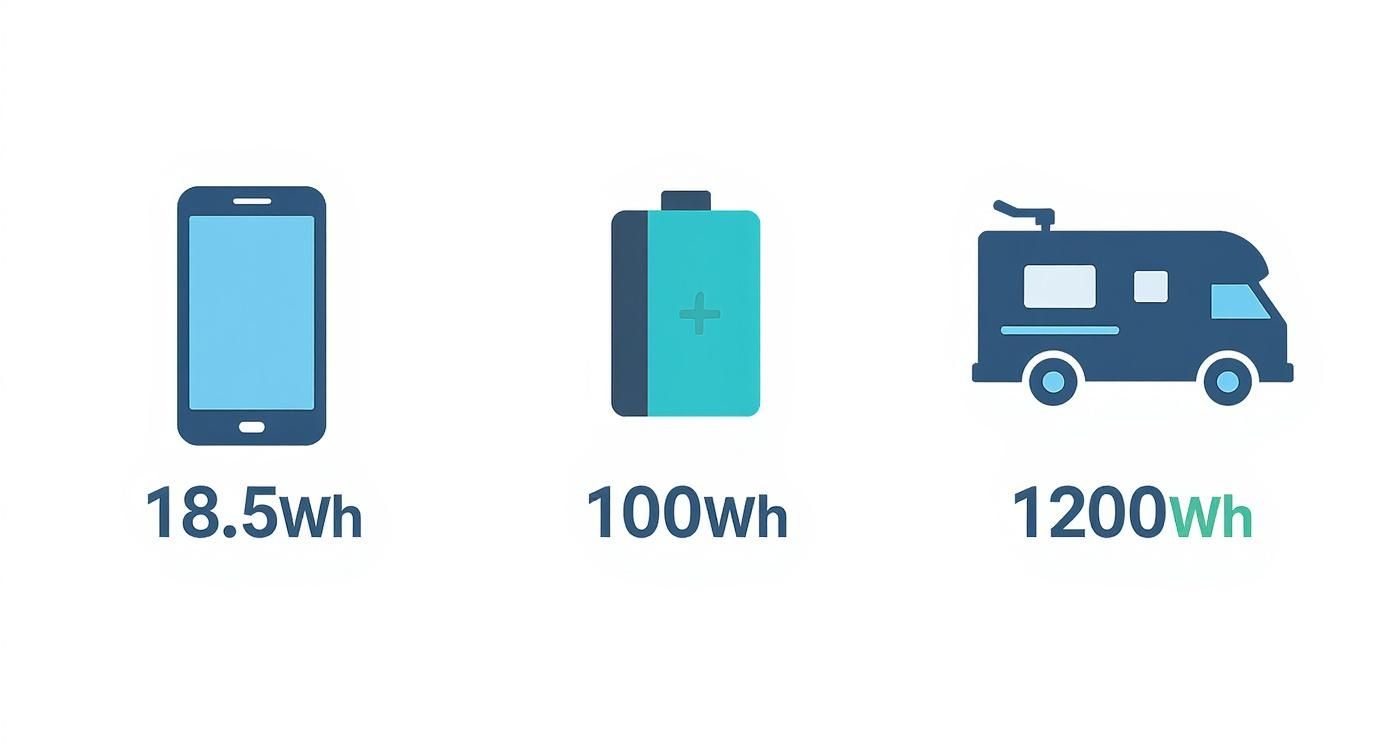
This chart really puts it into perspective, showing how watt-hours provide a clear measure of energy across different batteries.

Infographic showing the watt-hour capacity of a smartphone, power bank, and RV battery.

It's easy to see that while a power bank has much more juice than a phone, an RV battery is in a completely different league.

Travel Safely and Without Hassle

This might be the most critical reason of all. Airline rules for carrying batteries are almost always based on watt-hours. The Federal Aviation Administration (FAA) and other international groups set strict limits—typically around 100Wh per battery—to keep flights safe.

If you show up at airport security with a massive power bank labeled only in mAh, you might have a problem.

But if you’ve already done the simple math—Ah × V = Wh—you'll know instantly whether your gear is okay to fly. Being able to confidently show a security agent that your 20,000mAh (74Wh) power bank is well under the 100Wh limit can save you a world of hassle and ensure your essential power source makes the trip with you.

What Affects Real-World Battery Performance

A car battery being tested with a multimeter, showing the practical side of checking battery health.

While our amp hour to watt hour formula gives you a solid starting point, the real world is a bit different. That watt-hour number on the label represents the battery's potential under perfect lab conditions. But once that battery is in your phone, your power bank, or your camper, things change.

Think of it like the official mileage sticker on a new car. It gives you a specific MPG rating, but your actual mileage will always depend on how you drive and the weather. Batteries work the same way; their performance isn't a fixed number.

Knowing these factors isn't about making things complicated. It’s about setting realistic expectations for how your devices will actually perform day-to-day.

Voltage Isn't Always Constant

The simple conversion formula, Wh = Ah × V, assumes that voltage is a steady number. In reality, a battery's voltage isn't a flat line—it gradually drops as the battery is used. A fully charged phone battery might start at 4.2V but can fall to 3.0V or even lower by the time it's empty.

This natural voltage drop means the actual energy you get can be a bit different from the official rating. For example, a 24V battery rated at 100Ah is listed as 2,400Wh, but the real-world output will change because of this voltage drop.

Your battery's voltage is more like a slow, steady decline than a flat line. This natural drop during use is one of the main reasons the calculated watt-hours and the real-world performance don't always match perfectly.

External Factors That Drain Your Power

Besides voltage, several other things can affect your battery’s true output. Keep these in mind, and you'll get a much better sense of how to get the most out of every charge.

Three major factors are always at work:

  • Extreme Temperatures: Heat and cold are enemies of batteries. Freezing weather can temporarily reduce a battery's capacity by 20% or more, while too much heat speeds up permanent damage.
  • How Fast You Use Power: Pulling a lot of power out quickly is less efficient than a slow, steady drain. Running a high-power appliance like a microwave will use up your battery's energy faster than using the same amount of energy to power an LED light over a longer time.
  • Battery Age and Health: Like all things, batteries wear out. Every charge and discharge cycle slowly reduces a battery's ability to hold a full charge.

Managing these factors, especially temperature and your charging habits, is key. You can learn more about the impact of temperature and charging rates on lithium-ion cells in our detailed guide. This is exactly why we built Chargie—to manage these very issues, helping your battery last longer by preventing the stress that makes it age faster.

Putting It All Together: Your Battery Capacity Questions Answered

Even with the formula in hand, it's normal for a few questions to pop up. Getting a real feel for how amp-hours, watt-hours, and voltage all work together takes a bit of practice.

Let's look at some of the most common questions people ask. These practical points can help make the concepts clearer.

Can I Convert Watt Hours Back to Amp Hours?

You absolutely can. The math works just as well in reverse. You just need to flip the formula around:

Amp-Hours = Watt-Hours ÷ Voltage (Ah = Wh / V)

This is incredibly handy. Imagine you're setting up a solar power system and figure out you need 2,000Wh of energy per day. If you're building it around a 12V battery system, you now know what to look for: 2,000Wh ÷ 12V = 166.7Ah. You'd probably buy a 200Ah battery to have a bit of a safety cushion.

For anyone planning a bigger project like this, understanding solar battery backup costs is a huge part of the equation, and it all starts with getting this capacity calculation right.

Why Do Power Banks Advertise mAh Instead of Wh?

Honestly, it's mostly a marketing gimmick. A huge number like 20,000mAh just sounds more powerful to the average person than its actual energy rating of 74Wh.

Manufacturers get that giant mAh number by using the low 3.7V of the small battery cells inside the power bank. While it's technically correct for those internal cells, it's not a true measure of the power bank's usable energy, especially since it has to increase the voltage to charge your 5V phone.

This is exactly why watt-hours (Wh) is the gold standard. It's the only truly universal way to measure a battery's total stored energy. It's no accident that safety regulators and airlines rely on it.

Does This Conversion Work for Car Batteries Too?

Yes, it works for everything. The relationship Wh = Ah × V is a basic principle of electricity. It doesn't matter what kind of battery you're looking at.

This formula applies to:

  • Standard lead-acid car batteries
  • The lithium-ion batteries in your phone and power banks
  • Large Lithium Iron Phosphate (LiFePO4) batteries used in RVs
  • Even your rechargeable AA batteries

The only thing that changes is the voltage you use in the formula. For a typical car battery, that's 12V. For a big truck, it might be a 24V system. As long as you use the correct voltage for the battery you have, the math will always give you the correct watt-hour capacity.


Here at Chargie, we believe understanding your battery is the first step to making it last. By intelligently managing your charging cycles and keeping your battery from sitting at 100% for hours on end, our smart charging device can dramatically extend the life of your phones and laptops. This saves you money, reduces e-waste, and gives you a better experience. Find out how to get more out of your devices at https://chargie.org.

Chargie is a smart charging device designed to extend the lifespan of your phone's battery by limiting overnight charging.

Company

Lighty Electronics SRL
42 Viorelelor st
305500 Lugoj, Romania

EU VAT: RO35245011

© 2019-2026 Lighty Electronics SRL. All Rights Reserved.

Add to cart