

How To Conserve iPhone Battery And Make It Last Longer
We've all been there: you look at your iPhone, and it's barely noon, but your battery is already low. It’s a sinking feeling. Before you start getting lost in confusing settings, let's talk about the quick wins—the simple changes that make a real difference, right now.
Your Five-Minute Fixes For Better Battery Life
You don't need to be a phone expert to get your battery life back. A few smart taps can have a big effect, controlling the biggest power users without changing how you use your phone.
Think of this as your emergency checklist. We're going to fix the features that drain power the fastest, and it will take less time than making a cup of coffee.
The Biggest Battery Hogs and How to Tame Them
So, what are the usual problems? Your iPhone’s beautiful screen is one of the biggest. The brighter it is, the faster it uses power. It's a simple cause and effect.
The other major power drain happens in the background. Apps are always updating, checking your location, and sending you notifications. All these things use up your battery, even when your phone is in your pocket. These background activities can easily drop your daily usage from a solid 8–9 hours down to just 6. For a deeper look at what affects your iPhone's battery, check out our article about iPhone battery saving tips.
The good news is that you have complete control over these features.
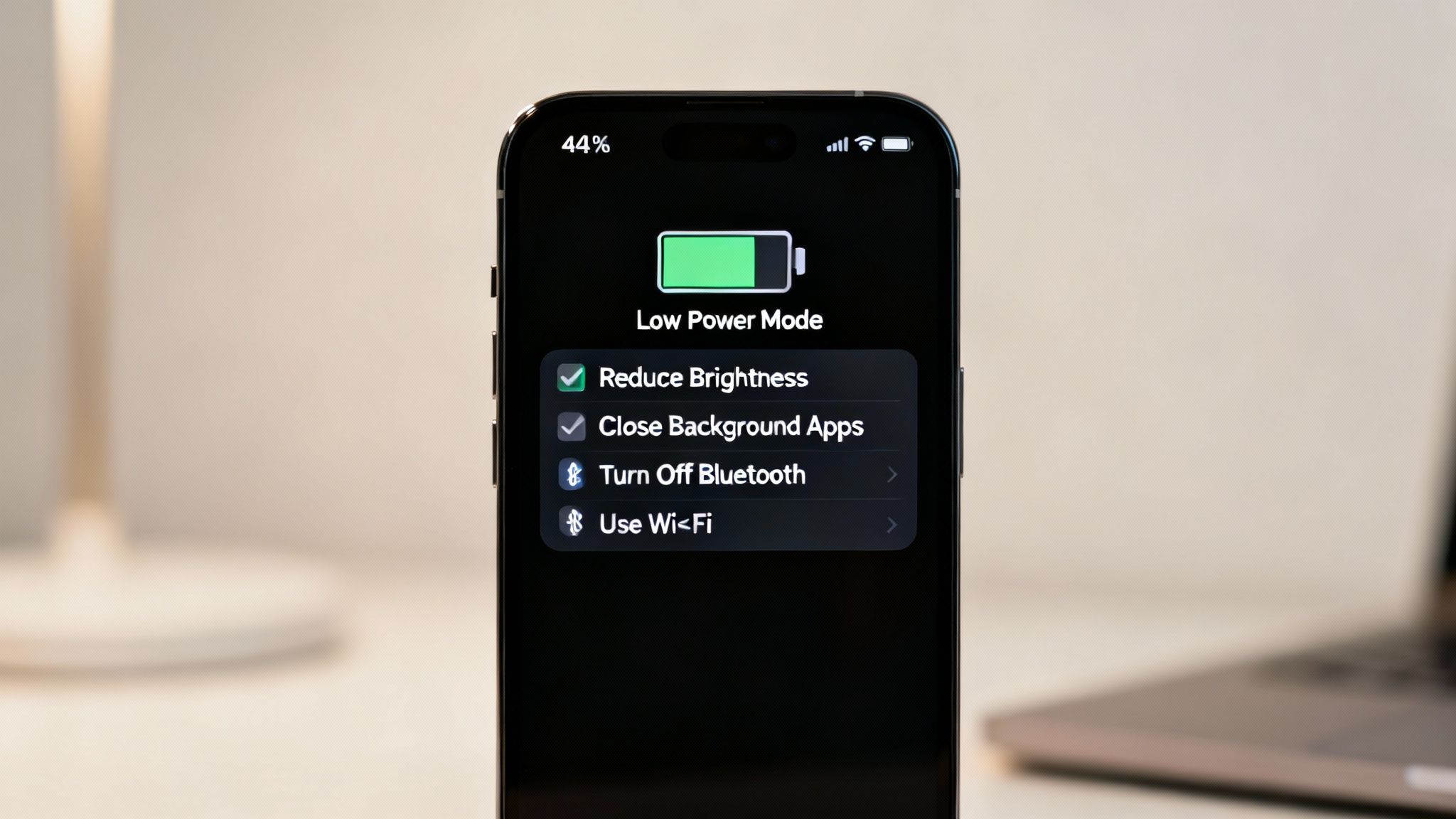
Pro Tip: Don't just save Low Power Mode for when you're at 10%. I've made a habit of turning it on around 30% or 40%. It’s a great way to make sure my phone lasts through a long evening without me having to look for a charger.
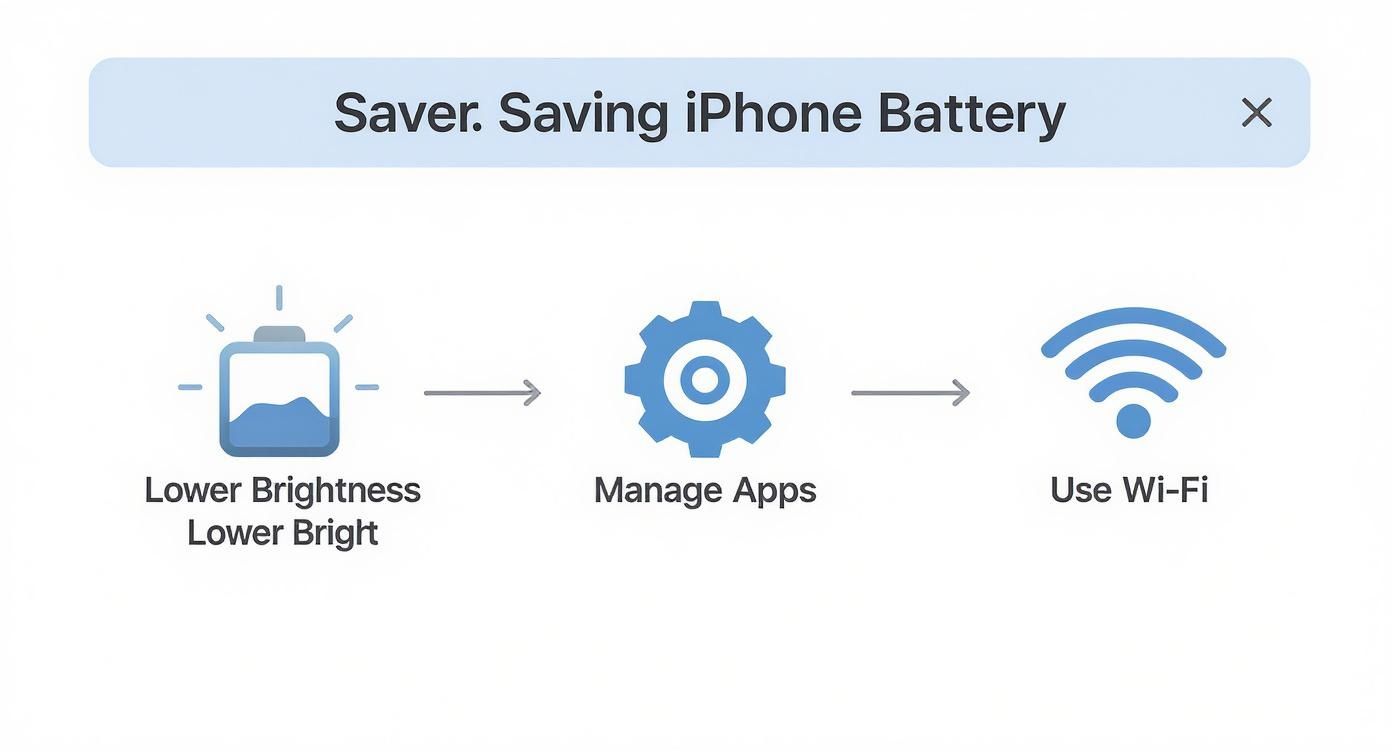
The table below shows five of the best things you can do right away to fight these common battery drainers.
Top 5 Quick Fixes for iPhone Battery Drain
Here’s a look at the most powerful changes you can make in just a few minutes. Each one deals with a specific power-hungry feature and tells you exactly where to go to fix it.
| Quick Fix | What It Solves | How to Do It |
|---|---|---|
| Enable Low Power Mode | Reduces overall power use by limiting background activity, fancy screen effects, and some network features. | Go to Settings > Battery and turn on Low Power Mode. You can also add it to your Control Center for one-tap access. |
| Lower Screen Brightness | The screen is one of the biggest power users. Lowering its brightness is the single best quick fix. | Swipe down to open the Control Center and drag the brightness slider down. Or go to Settings > Display & Brightness. |
| Turn Off Background App Refresh | Stops apps from getting new information in the background, which is a major hidden battery drain. | Go to Settings > General > Background App Refresh and either turn it off completely or for certain apps you don't need updating all the time. |
| Manage Location Services | Stops apps from constantly using GPS, which uses a lot of power. | Go to Settings > Privacy & Security > Location Services. Set apps to "While Using" or "Never" instead of "Always". |
| Reduce Push Notifications | Fewer notifications mean your screen lights up less often, saving a surprising amount of power over a day. | Go to Settings > Notifications and turn off notifications for apps that don't need to alert you instantly. |
Learning these five simple habits is the first and most important step. Once you’ve done these, you can move on to the more advanced tips we’ll cover next.
Digging Into Your iPhone Settings To Stop Hidden Drains
Beyond the quick fixes, your iPhone's Settings app holds the real key to amazing battery life. Many of the default features run quietly in the background, constantly using power without you even knowing. Taking control of these settings is the next step to truly master your iPhone's battery and make it through even the busiest days.
Let's go on a quick tour of the most important settings, and I'll show you exactly what to change and why. These aren't just random switches; each change is meant to stop a specific type of hidden power drain.
Tame The Power of Background App Refresh
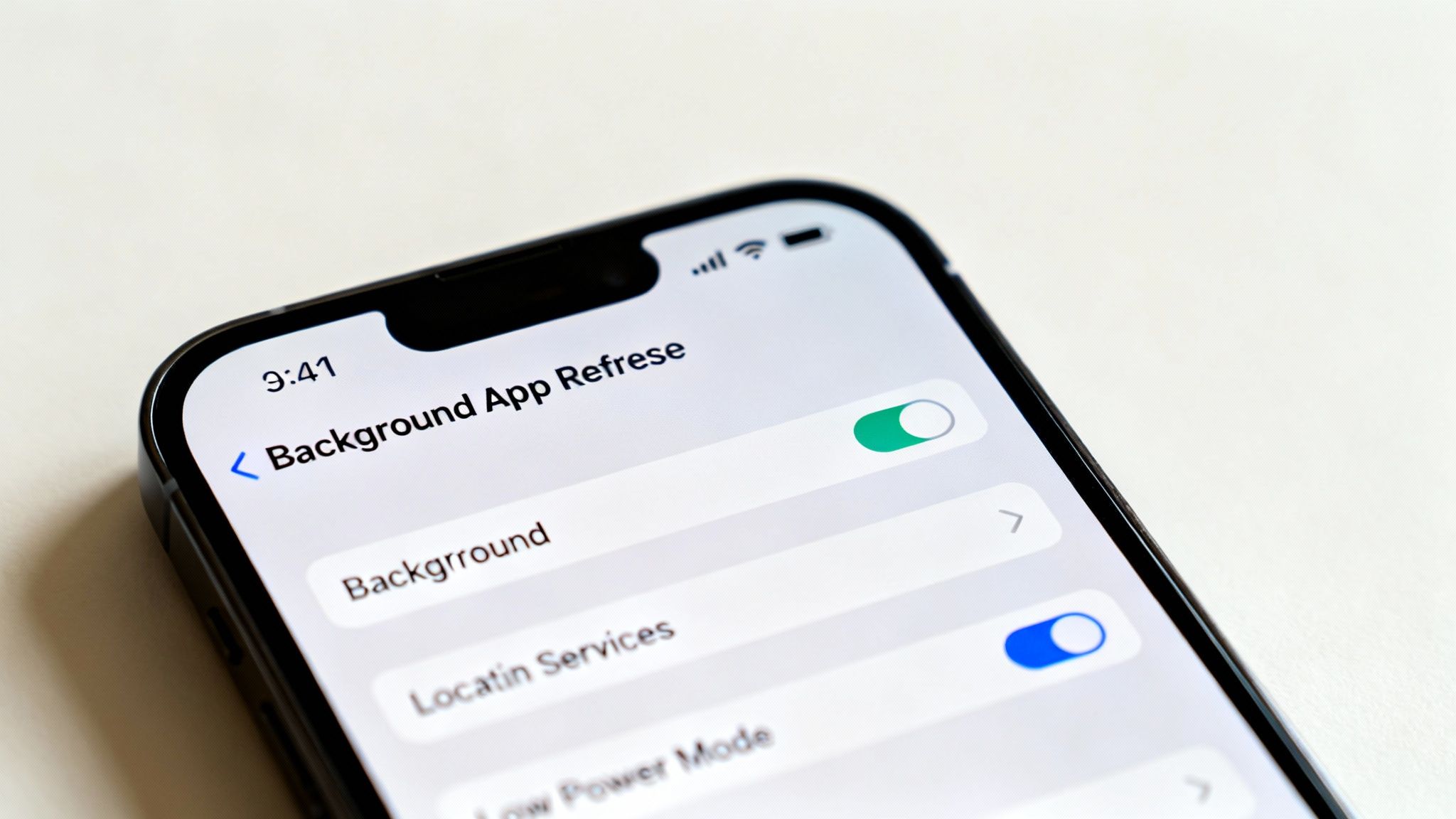
Background App Refresh is a classic battery hog. It's the feature that lets your apps check for new things even when you aren't using them. While that’s handy for your email or news app, it becomes a huge power drain when dozens of apps are all trying to update at once.
Instead of just turning it on or off, think smart. Which apps really need to be perfectly updated the moment you open them? Probably only a few.
You can control this by going to Settings > General > Background App Refresh. From there, you have a few options:
- Turn it off completely for the most savings.
- Set it to Wi-Fi only, which stops apps from using your phone's data plan to refresh.
- The best way: Go through the list and turn it off for apps that don't need constant updates, like a game or a photo editor.
Fine-Tune Your Location Services
GPS is one of the most power-hungry things your phone does. It's amazing how many apps ask for your location but don't actually need it to work. Sure, a weather app might need your location once when you open it, but a social media app probably doesn't need to track you all the time.
Go to Settings > Privacy & Security > Location Services. You'll see a list of every single app that has asked for your location. Look at this list carefully and be strict.
- Never: For apps that have no reason to know where you are.
- Ask Next Time Or When I Share: This is a great option that makes the app ask for permission each time.
- While Using the App: This is the best setting for most apps that need your location to work, like maps or ride-sharing services. It makes sure they only use GPS when you have them open.
- Always: Save this for only the most important apps. It lets them use your location at any time, which can really drain your battery.
I found a huge problem on my own phone: a shopping app that was set to "Always." It was using my location in the background to send me ads for nearby stores. Changing it to "While Using" stopped that hidden drain immediately.
Reduce Motion and Unnecessary Visual Effects
Your iPhone is full of beautiful, smooth animations that make it feel nice to use, but they also make your phone's brain work a little harder. While each little animation doesn't use much power, it adds up over thousands of times you use your phone each day.
To turn them down, go to Settings > Accessibility > Motion and turn on Reduce Motion. This replaces some of the fancier animations, like the 3D effect on your home screen, with simpler, faster ones. It might feel a bit different at first, but many people end up liking the quicker feel and the small battery savings it gives.
Rethink How Your iPhone Gets Mail
Here's a big one. If you don't need to see every single email the second it arrives, changing your Mail settings can be a huge power saver. The normal "Push" setting keeps a constant connection to your email server, which uses up energy.
Go to Settings > Mail > Accounts > Fetch New Data. Here you can turn off Push and choose a "Fetch" schedule instead. Setting your phone to get new mail every 15 or 30 minutes—or even only when you open the app—means it only checks for new messages at set times. It's a small change that saves a surprising amount of battery.
Manage 5G for Better Battery Life
5G is very fast, but it can also be a real battery killer, especially if the 5G signal in your area isn't strong and your phone is always searching. Luckily, Apple gives you smart ways to manage this.
Go to Settings > Cellular > Cellular Data Options > Voice & Data. You'll see three choices:
- 5G On: This forces your iPhone to use 5G whenever it's available, which can drain the battery faster.
- 5G Auto: This is the best setting for most people. Your iPhone will only use 5G when it won't hurt battery life too much, switching to 4G/LTE for easier tasks.
- LTE: If you're really struggling with battery and don't need top speeds, switching to LTE can give you a very noticeable boost.
By learning these specific settings, you can stop those quiet drains that use up your battery all day long, giving you more power when you actually need it.
Simple Daily Habits For A Longer-Lasting Battery
Changing your iPhone’s settings is a great start, but it's only half the battle. The small choices you make every day—your digital habits—are just as important for keeping your battery going strong. These aren't huge life changes, just simple, smart changes that really add up.
Interestingly, many common "battery-saving" tricks are actually myths. What feels like a smart move can sometimes backfire and drain your battery even faster. Let's bust a few of those myths and build some simple routines that really work.
Stop Force-Quitting Your Apps
This is probably the most common habit out there: swiping up to close every single app. It feels like you're cleaning up and freeing up power, right? In reality, this can actually hurt your battery life more than it helps.
When you switch away from an app, your iPhone puts it in a sleep state in its memory, where it uses almost no power. When you force it to close, the system has to shut it down completely. The next time you open that app, your iPhone has to load everything from the beginning, which uses way more power and, you guessed it, more battery.
The only time you should ever force-quit an app is if it's frozen, crashed, or just acting weird. Otherwise, let your iPhone do its job. It's made to manage background apps well.
Prioritize Wi-Fi Over Cellular Data
How your iPhone connects to the internet has a huge effect on battery drain. Whenever you can, connect to a trusted Wi-Fi network. It takes far less energy for your phone to stay on a Wi-Fi connection than a cellular one.
This is especially true when you're in a place with a weak cell signal. If your iPhone is struggling with just one or two bars, its cellular parts have to work extra hard just to find and hold onto a signal, which is a huge battery killer. It’s like the difference between a quiet conversation and shouting across a noisy room—one takes a lot more effort.
If you know you're headed into an area with bad service, like a basement or a rural area, and you don't need data, just turn on Airplane Mode. It's a fantastic battery-saving move.
Be Mindful of Extreme Temperatures
Phone batteries have a comfort zone. They're happiest when they are in temperatures between 62° to 72° F (16° to 22° C). Putting your iPhone in extreme heat or cold can cause both immediate battery drain and long-term damage.
Leaving your phone on the dashboard of a hot car can permanently damage its battery. Likewise, using it in freezing weather can temporarily reduce its ability to hold a charge.
- Avoid direct sunlight: Don't leave your phone baking on a beach towel or a windowsill.
- Keep it out of hot cars: A car's inside can heat up to dangerous levels in minutes.
- In the cold, keep it close: Put it into an inside pocket where your body heat can keep it warm.
It’s also worth noting that newer iPhones are just better at this. For example, the iPhone 15 Pro Max can last for about 9 hours and 35 minutes of heavy use, while an older iPhone 12 might only give you 6 hours and 36 minutes. Newer models have better power management and heat controls, which makes a big difference since heat is a major enemy of battery health.
Manage Notifications To Reduce Screen Wake-Ups
Every single time your screen lights up for a notification, it uses a little bit of power. One notification is nothing, but hundreds throughout the day? That adds up to a serious drain. Every buzz and every notification sound also adds to it.
Take control of your notifications to stop the constant screen wake-ups. Try using the Scheduled Summary feature for apps that aren't urgent. It groups their notifications and delivers them in one or two batches per day, which cuts down on interruptions and power use.
Beyond that, even your media habits can make a difference. Consider exploring the best offline music apps for your commute or workout. When you're not constantly streaming over Wi-Fi or cellular, you’re saving a surprising amount of power. It's a simple change that pays off.
Charging Your iPhone the Right Way
How you charge your iPhone is just as important as how you use it day-to-day. There's a lot of confusing advice out there, so let's clear up the myths and focus on what actually works. Using these habits won't just help your battery last longer today; it'll keep it healthy for years to come.
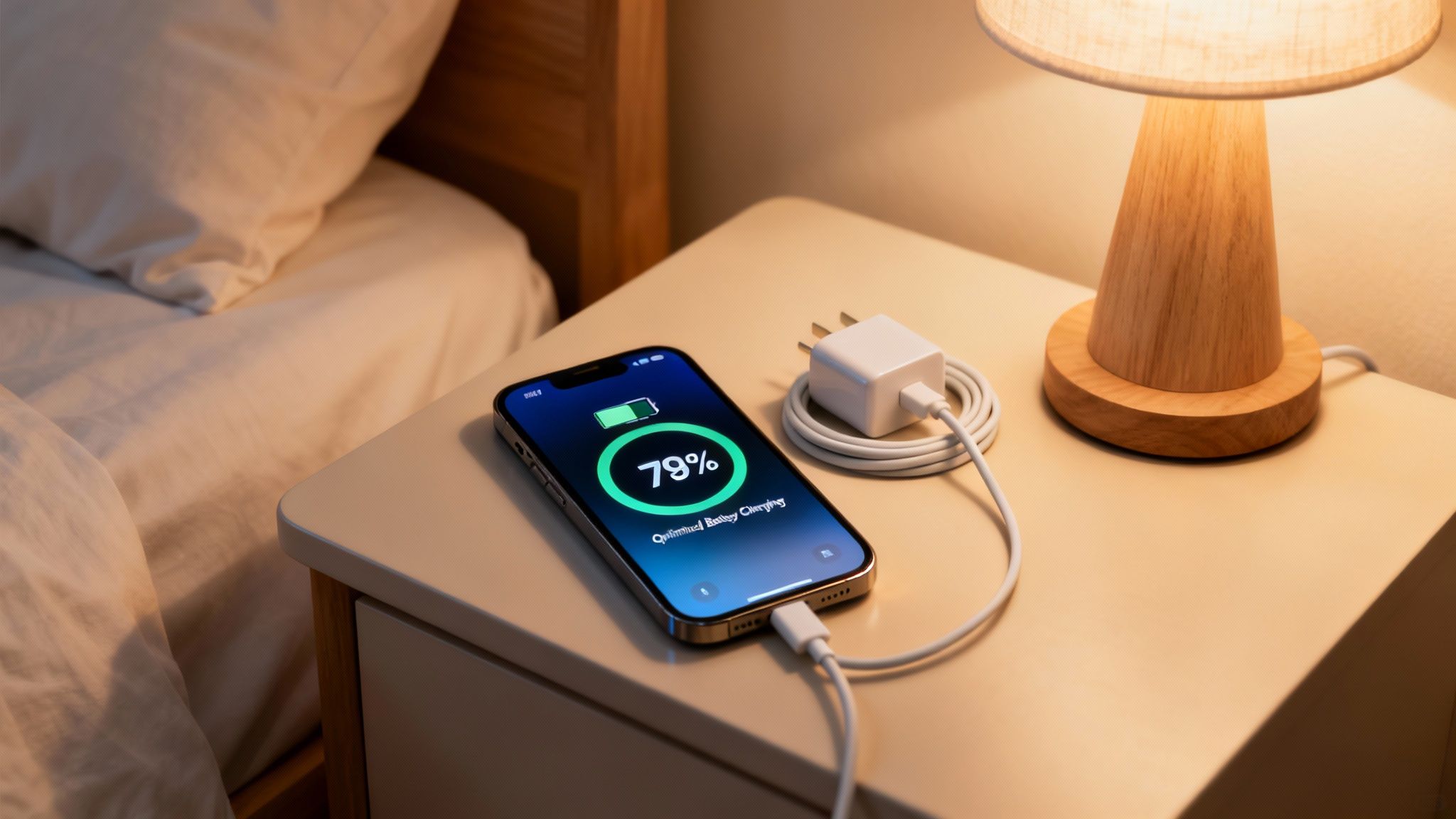
Most of us do this: plugging in our phones overnight and waking up to a 100% charge. It feels good, but keeping a battery at a full charge for hours puts a lot of stress on it. Over time, this habit can actually make your battery age faster.
But don't worry, this doesn't mean you have to give up charging overnight. Apple has built some pretty smart software to handle this for you.
Let Optimized Battery Charging Do the Heavy Lifting
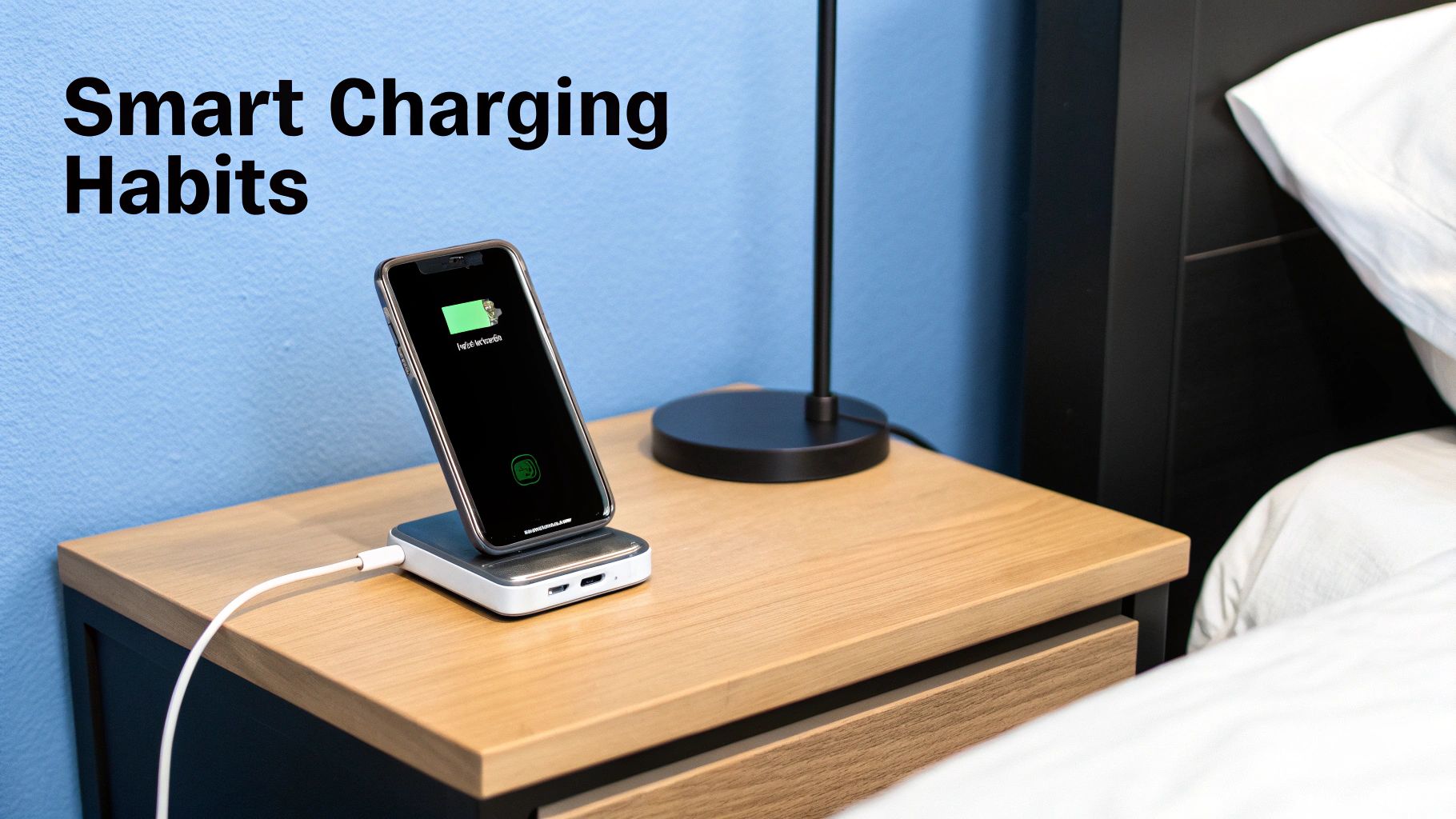
To fight the stress of sitting at full charge, Apple created Optimized Battery Charging. You can find it in Settings > Battery > Battery Health & Charging.
When you turn it on, your iPhone starts learning your daily routine. It’ll charge up to 80% and then cleverly pause, waiting to finish that last 20% right before you usually wake up and unplug it.
So, if your alarm goes off at 7 AM, your phone will hit 80% and then just wait there for most of the night. It only starts the final charge in the hour or so before you need it. This simple trick greatly cuts down the time your battery spends at that stressful 100% mark.
It’s a fantastic set-it-and-forget-it feature that protects your battery's long-term health without you having to think about it. If you want to learn more about smart charging, this is a great guide on when to charge your iPhone for optimal health.
The 20-80% Sweet Spot
You've probably heard people talk about the "20-80 rule." The idea is simple: the best range for a phone battery is to keep its charge somewhere between 20% and 80%. Letting it constantly drop to 0% or sit at 100% causes way more wear and tear.
Think of it like a rubber band. If you're always stretching it to its absolute limit, it's going to wear out fast. For iPhone 15 models, Apple made this even easier by adding an 80% Limit setting that stops the phone from charging past that point at all.
This is all because of how these batteries work. They lose a little bit of their total capacity with every charge. Apple designs its modern batteries to keep 80% of their original capacity after about 1000 full charges—a huge improvement over older models.
Debunking Common Charging Myths
Before we move on, let's look at some of the most common myths I hear about charging. It's easy to get bad advice, so let's set the record straight.
Charging Myths vs. Reality
| Common Myth | The Reality |
|---|---|
| You should always let your battery drain to 0% before charging. | False. This was true for old types of batteries but is bad for modern ones. Small charges are much healthier. |
| Leaving your phone plugged in overnight will "overcharge" it. | Not exactly. Modern iPhones stop charging at 100%. The real problem is the stress of being held at full charge, which Optimized Charging helps fix. |
| Any cheap charger is fine. | Nope. Only use MFi-certified chargers. Uncertified ones from the gas station can be dangerous and cause serious damage to your battery. |
| Fast charging will destroy your battery. | It's a trade-off. Fast charging creates more heat, but iPhones manage this to reduce damage. It’s safe, but slower charging is cooler and gentler. |
Getting these basics right is key. Using a certified charger and paying a little attention to your charging habits can make a massive difference in how long your battery—and your iPhone—lasts.
Pinpointing and Fixing Severe Battery Drain
Sometimes, even after trying your best, your iPhone's battery still drains with scary speed. If you've tried all the usual tricks and your battery life is still a problem, it’s time to play detective. The good news is your iPhone has the tools you need to see exactly what’s going on and find the real source of a major power drain.
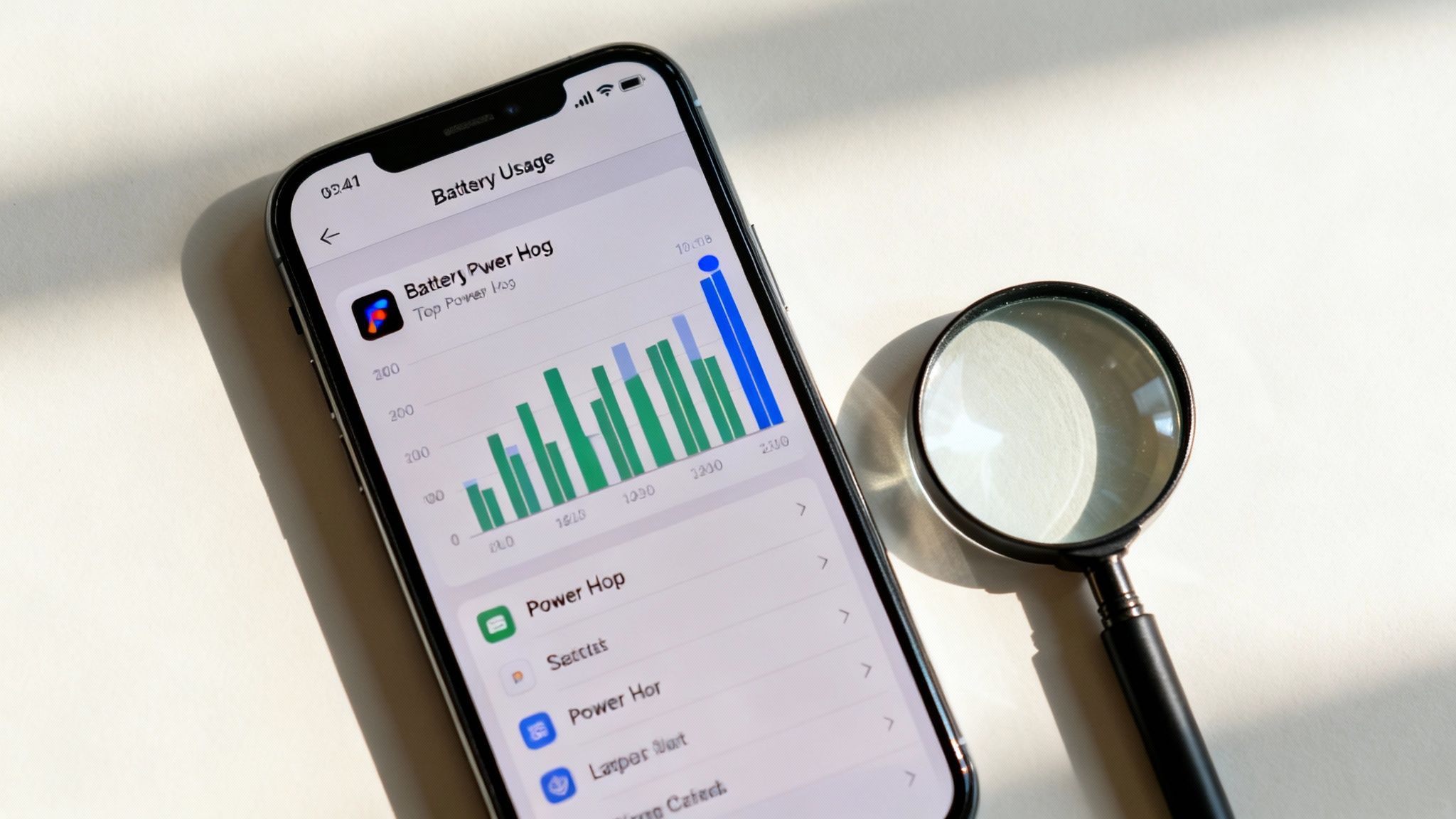
This is about moving from guessing to knowing. Instead of just randomly turning things off, you can find the specific app or process that's causing trouble and deal with it directly.
Become a Battery Detective
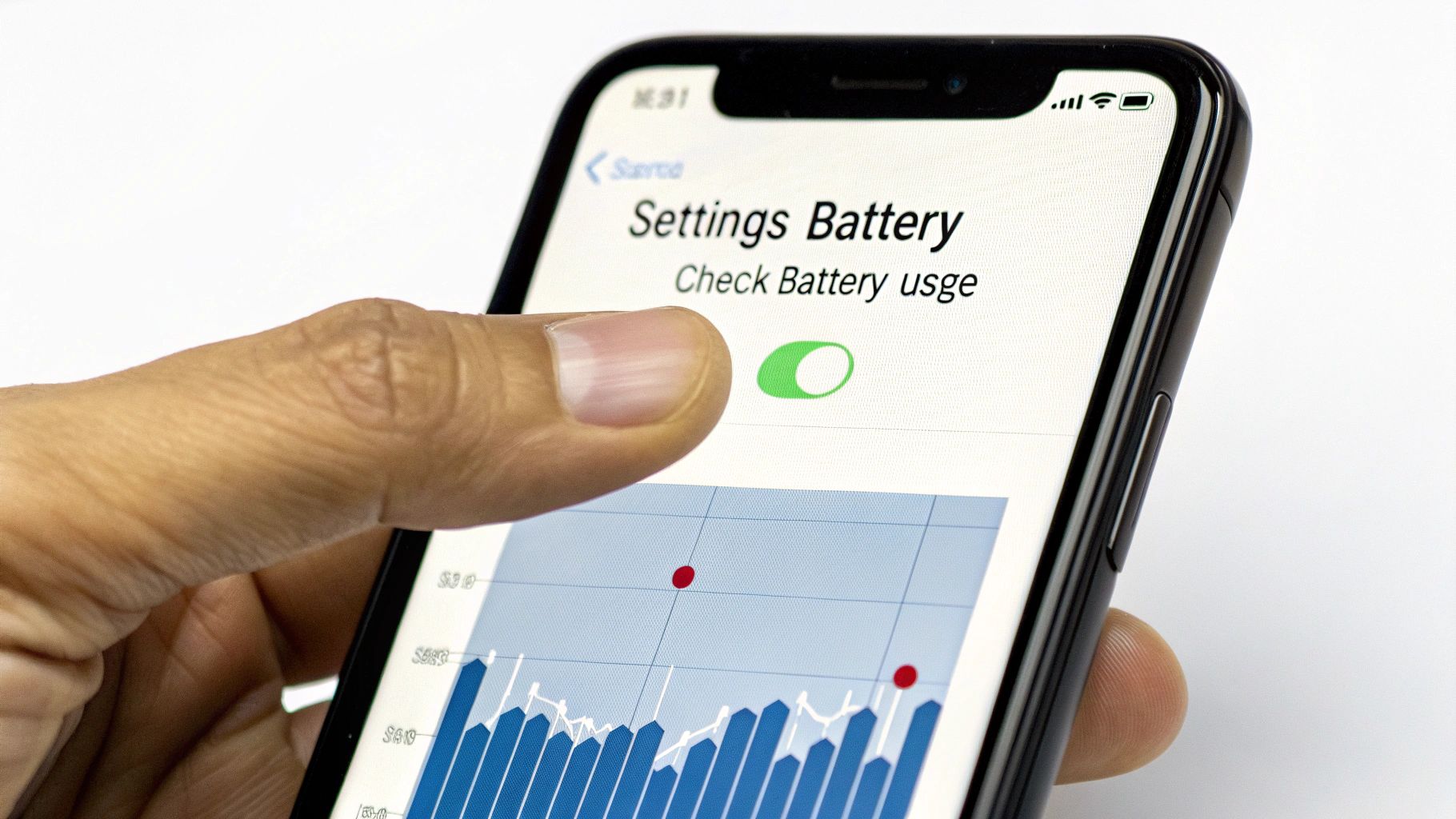
Your first stop is your iPhone's built-in battery screen. Go to Settings > Battery and give it a moment to load. This is your main hub for understanding exactly where all that power is going.
You'll see a couple of graphs: one showing your battery level over the last 24 hours (or 10 days), and another showing your activity. Below that is the most important part—a list of apps ranked by how much battery they've used. This is where the clues are hiding.
Tap the list to switch between Battery Usage and Activity. Keep a close eye on any "Background Activity" label you see under an app's name. If an app you barely use is showing a lot of background activity, you've likely found the problem.
I once had a social media app I hadn't even opened all day use up 30% of my battery in the background. That's a huge red flag. It usually means something is wrong with the app itself, like it's stuck trying to get new data.
Reading the Clues in the Graphs
Those graphs at the top tell a story. Look for any steep, sudden drops in your battery level. Now, match that time with the activity chart right below it. Was your screen on and were you using the phone? Or did the drop happen while the phone was supposed to be resting?
This helps you figure out the when and why:
- Is the drain happening while you're actually using an app? If so, a heavy-duty app like a game or streaming service is the obvious cause.
- Is the drain happening overnight? This points to a background app that's not behaving. It could be a misconfigured email account constantly trying to sync or just a buggy app that won't go to sleep.
- Did the battery drop sharply right after an iOS update? It happens. Sometimes a new version of iOS can cause unexpected battery issues on certain devices.
By looking for these patterns, you can go from a vague "my battery drains fast" to a specific "my battery dies between 2 AM and 4 AM because of this one app's background activity." For a deeper look at these steps, check out our guide on what to do when your iPhone battery drains fast.
Common Culprits and How to Fix Them
Once you have a suspect, it's time to take action. Thankfully, most of these issues are pretty common and have simple solutions.
The Buggy App
If one app is using a crazy amount of power, especially in the background, it's probably just bugged.
- Check for an Update: First thing's first, go to the App Store. App makers often release fixes for battery-draining bugs pretty quickly.
- Delete and Reinstall: If an update doesn't solve it, try deleting the app completely and reinstalling it. This can often clear out bad data that's causing the problem.
- Cut Off Its Background Access: As a last resort, go to
Settings > General > Background App Refreshand just turn it off for that specific app.
A Problematic iOS Update
While not super common, it's possible for a major iOS update to mess with battery life. If you notice a huge drop in battery life right after updating, the first thing to try is a simple restart.
Press and hold the side button and one of the volume buttons until the power-off slider appears. Shut it down, wait about 30 seconds, then turn it back on. You'd be surprised how often this clears up small software problems.
Bad Network or Email Settings
If your iPhone is constantly looking for a stable Wi-Fi or cellular signal, it will be working overtime and killing your battery. The same goes for an email account that can't sync properly—it will just keep trying over and over again, draining power in the background.
A great troubleshooting step here is to reset your network settings. Go to Settings > General > Transfer or Reset iPhone > Reset > Reset Network Settings. Just know that this will erase all your saved Wi-Fi passwords, so you'll have to log back into your networks.
If you think an email account is the problem, try turning it off for a bit in Settings > Mail > Accounts. If the battery drain stops, you've found the issue. You'll likely need to remove the account and add it back again to fix it.
iPhone Battery Questions We All Have
Even with all the tips in the world, a few common questions always seem to come up about iPhone batteries. Let's clear the air and answer some of the most common questions and mysteries.
Is Leaving My iPhone Charging Overnight Really That Bad?
Not really, and you can thank a clever little feature called Optimized Battery Charging for that. Your iPhone actually pays attention to your daily routine. It charges up to 80% and then pauses, waiting to finish that last 20% right before you typically grab it in the morning.
This simple trick greatly cuts down on the time your battery sits at 100%, which is a high-stress state for batteries. So go ahead, plug it in at bedtime. The software is smart enough to protect your battery's long-term health while you get some rest.
Should I Be Closing My Apps to Save Battery?
This is probably the biggest battery myth out there, and the short answer is no. In fact, constantly swiping up on all your apps can actually make your battery life worse.
When you switch away from an app, your iPhone puts it into a sleep state where it uses almost no power. Forcing it to close removes it from your iPhone's memory completely. The next time you need that app, your phone has to do all the heavy work to launch it from scratch, which burns more power than simply waking it from its sleep state.
My rule of thumb: Only force-quit an app if it's genuinely not working right—frozen, glitchy, or not responding. Otherwise, let your iPhone do its job. It's made to manage background apps well.
So, When Is It Actually Time to Replace My iPhone Battery?
Apple’s official advice is to think about a new battery once its health drops below 80% of its original capacity. It's easy to keep an eye on this yourself. Just go to Settings > Battery > Battery Health & Charging.
You'll definitely feel it when it gets below that 80% mark. The phone won't last nearly as long, and you might even notice it slowing down a bit during hard tasks. A fresh battery can honestly make an older iPhone feel like new again, giving it a whole new lease on life.
Does 5G Drain the Battery Faster Than Wi-Fi or 4G?
Yes, it sure can. 5G uses a lot of power, especially if you're in an area where the signal is weak. Your phone has to work much harder to find and hold onto that connection, which directly leads to more battery drain.
For most of us, leaving the phone on its default "5G Auto" setting is the best move. It’s smart enough to use 5G when you need the speed for big downloads or streaming, then drop back to the more efficient 4G/LTE for everything else. But at the end of the day, a solid Wi-Fi connection will always be the kindest option for your battery.
Take full control over your iPhone's charging habits and extend its lifespan with Chargie. This smart device and app combo allows you to set precise charging limits, preventing the overnight damage that slowly degrades your battery. Learn more and get yours at https://chargie.org.